
In this #coachbetter episode, Diana shares a major “aha” moment that we see consistently across our global cohort community that will completely reframe the way you think about coaching conversations.
As coaches, we know the coaching conversation is essential to instructional coaching. It can feel intimidating—for both the coach and the coaching partner—to sit down without really knowing exactly where the conversation might go. So, we’re going to unpack the role of the coach during these conversations, to help you realize that, as an instructional coach, you do not have to have all the answers.
So many of our global cohort members place an unrealistic burden on themselves, assuming that being a qualified, reliable professional means they must possess an immediate solution for every instructional problem. But as our participants progress through the program, they experience a helpful shift in perspective.
A coach in our community captured this perfectly during his own reflections. After analyzing his daily interactions with teachers, he said that “the actual implementation of coaching does not need to be super-complicated, dense, or filled with lofty promises”. From his experience in the program, and his practice coaching conversations, he realized that “best practice was simple, straightforward, and meaningful.” What he realized is – and this is the mindset shift that we’re making in this episode – that coaches don’t have to be the expert all the time. His conclusion directly contradicts the initial pressure he felt to be an expert: Actually the work of coaching involves bringing out what is already within them, and not fix things or solve all the problems..
This breakthrough highlights a key distinction every coach must understand: the difference between role clarity and subject expertise.
Role clarity is about defining your role and expectations so you can communicate them seamlessly to your teachers and leadership. Without this foundation, schools experience confusion, miscommunication, and role misalignment. This can lead teachers, coaches and leaders to think that coaches are the experts, more like in-house consultants.
Possessing all the answers, however, is an issue of control. When you try to dictate the exact outcome of a conversation by providing immediate answers, you stop listening to your coaching partner. And you start stripping away their capacity, confidence and independence. This means that, as coaches, our job is not actually to have all the answers. Our job is to support and promote the deep thinking of our coaching partner. And the great news is questions to provoke thought do not need to be complicated or lengthy.
What’s YOUR level of coaching mastery?
All coaches go through various stages of coaching mastery. Once you identify where you’re at, you can begin to build the skills needed to move to the next stage.
This quiz is based on real-life case studies compiled from years of working with coaches inside The Coach Certificate & Mentorship Program!
When you receive your results, you’ll also get your matching case study from the STRIVE Case Studies to see where you fit in the stages of coaching mastery.
Ready to tackle your challenges and move on to the next level in YOUR coaching practice?
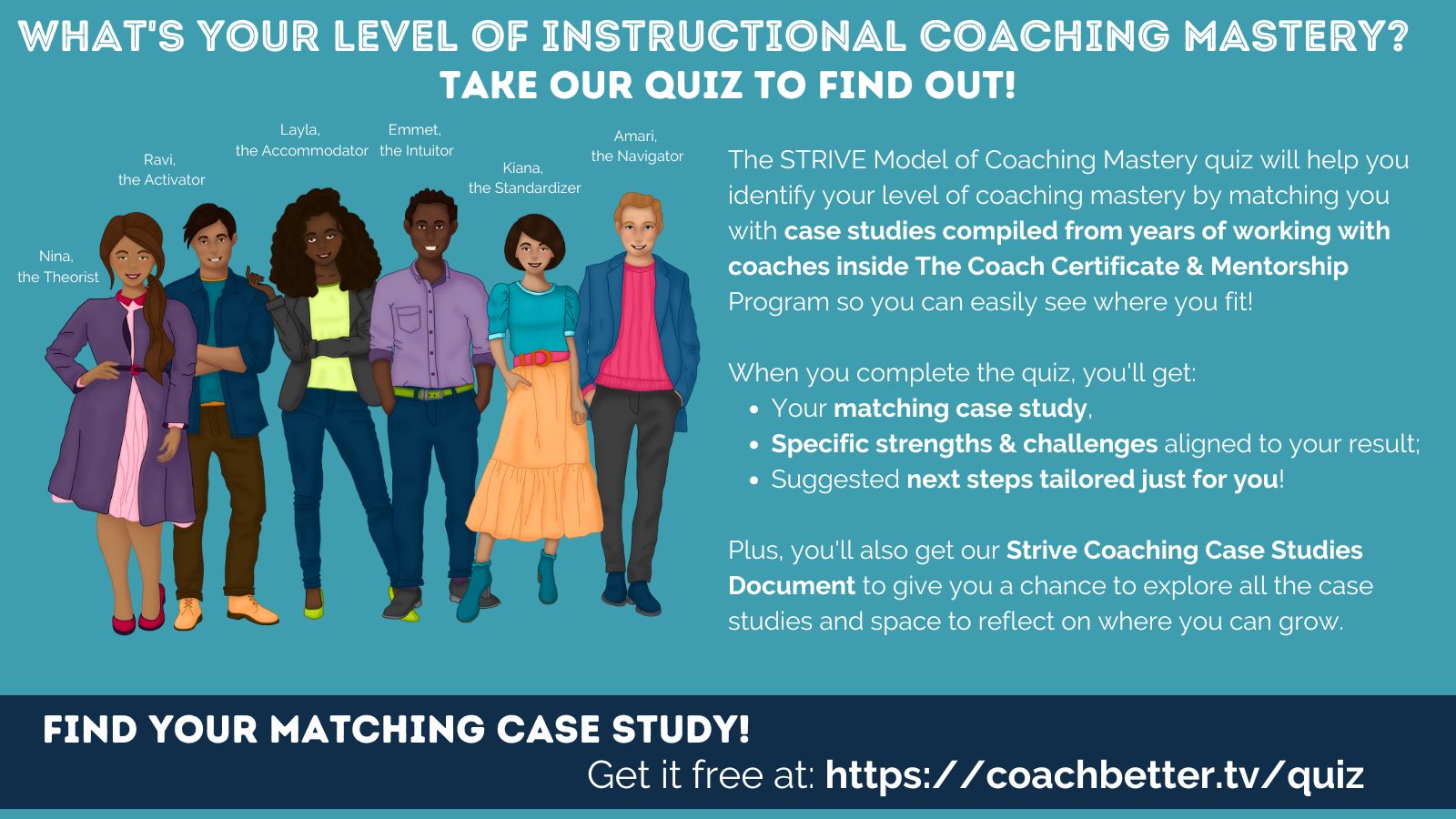
The STRIVE Model of Coaching Mastery quiz will help you identify your level of coaching mastery by matching you with case studies compiled from years of working with coaches inside The Coach Certificate & Mentorship Program so you can easily see where you fit!
When you complete the quiz, you’ll get:
- Your matching case study,
- Specific strengths & challenges aligned to your result;
- Suggested next steps for each stage;
Plus the Case Study Document includes:
- Case studies leveled by coaching mastery;
- A framework to identify essential stages of professional growth & key areas to focus on in your professional learning;
- Alignment with the THRIVE Model for a Successful Coaching Culture;
- Space for you to reflect & prioritize so you can take action immediately!
You’ll go straight to the Quiz, and get the Case Study Document via email.
When you operate under the assumption that you must be the primary expert in the room, you naturally default to a consulting stance. You analyze the data, you diagnose the problem, and you give a solution. When you do this, you handle the cognitive heavy lifting yourself, and inadvertently, you prevent the teacher from developing their own problem-solving skills.
However, when you embrace the idea that you don’t need to have all the answers, your approach changes. Rather than worrying about being a specific content area expert, the skill of planning, facilitating, and creating an inclusive conversation experience becomes your focus. Your job isn’t to pour knowledge into the teacher; it’s to hold up a mirror and use strategies like active listening, questioning, pausing, and paraphrasing to help them uncover their own insights.
This is the deep work of coaching. It’s about knowing our coaching partners, listening to their needs, and helping them recognize their own capacity. This means that coaches don’t need to come in with all the answers, but they do need to:
- Understand how to listen for the problem behind the problem – what their coaching partner is really struggling with
- Know how to ask the question that gets to the heart of the issue – and helps their coaching partner think
- Use paraphrasing, summarizing, and prioritizing to help their coaching partner identify their next step
- Be willing to learn, collect data, do some research and support the learning needs of their coaching partner (as needed)
We work on all of this in the Thrive Coaching Certificate program – where you not only learn about and practice having this kind of coaching conversation yourself, but you also get a mentor to support your learning along the way.
One of the key things all of our graduates understand is that when you let go of needing to have all the answers, you empower teachers as capable partners in their own growth.This consistency helps your coaching partner choose to opt into a coaching conversation because they know what to expect, and they feel a genuine sense of ownership and accountability throughout the process. If this is a skill you want to get better at, come join us in the Thrive Coaching Certificate program!
WATCH THE VIDEO OR LISTEN TO THE PODCAST
🔗 KEY LINKS FOR THIS EPISODE
Ready to create a coaching culture that improves student learning and builds belonging?
Come learn with me!
I help educators, instructional coaches, informal or positional leaders work together to create thriving coaching cultures that improve student learning and build belonging.
Coaching programs based on the Thrive Model, with clarity, consistency and community, can create time and space for educators to feel seen, heard, respected and valued for the experts that they are – creating a sustainable system of educator professional growth that ultimately improves student learning.
For this kind of coaching to thrive we need to focus on both the micro view of your coaching practice and the macro view of your coaching program, so while you’re developing your individual coaching practice you’re also intentionally developing a sustainable coaching culture.
If you’re ready to build this kind of coaching culture in your school community, join us for the Thrive Coaching Certificate program!

Wherever you are in your coaching journey, we can support you!
When you’re ready, there are three key ways we can work together:
- in the Thrive Coaching Certificate,
- in a private mentoring package, or
- through work directly with your school.
Leave a comment below, or reply to any of my emails and let’s start a conversation to see how we can work together to create a thriving coaching culture in your school setting!
Connect with us!
- Subscribe to the podcast iTunes | Spotify | Stitcher
- Follow us on social media: Instagram | LinkedIn | YouTube
- Join our #coachbetter Facebook group
- Read more from Kim: all books & articles
- Explore our courses for coaches
Recent Comments