
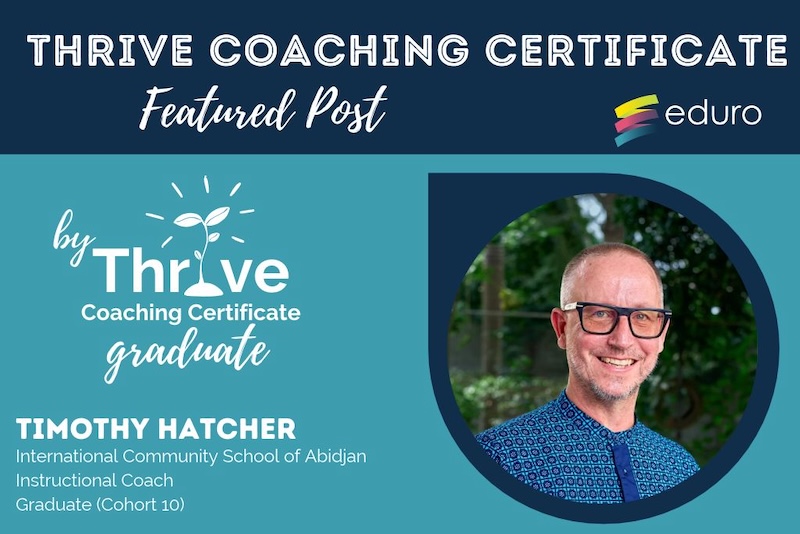
We want to give you a peek inside our Thrive Coaching Certificate. Educators taking part in this academic-year-long journey have graciously given us permission to post some of their learning and reflections from the private coursework they are undertaking during this program. Where possible, we have shared the course and the action task to give context for the guest post.
The Topic: Phase 1: Find Clarity
The Task: Reflect on the level of community buy-in for coaching in your school community.
How well articulated and understood is the definition of coaching?
The current, school-adopted definition of instructional coaching needs to be more fully developed because it focuses narrowly on coach activities (“conversations, modeling, co-planning, reflection”) rather than the fundamental purpose and philosophical commitments of the program.
Understanding is Mixed: Understanding is developing among the teachers I actively coach, as I deliberately model the process during sessions (using phases like Jim Knight’s Identify, Learn, and Improve cycle).
Deficit in Leadership: Understanding is not as strong among some key school leaders. Recent meetings show they view me as a problem-fixer or performance monitor for teachers, leading to conflicts when they request confidential progress reports.
What work needs to be done to clarify the vision or definition of coaching?
The primary work is to formally establish a revised definition that clearly articulates the “who, why, and what it is and what it is not” of coaching.
Revised Definition Focus:
My draft centers on the idea that instructional coaching serves the wider school community through a confidential, non-evaluative partnership. It stresses that it is an agentic process where individuals direct their own growth, aiming to empower stakeholders rather than “fix” them.
Strategic Action Plan:
Formalize the “Non-Negotiables”: The most immediate need is to clarify the role of confidentiality and teacher agency through a structured response. I am currently drafting a communication to leadership, leveraging resources (like the recent Edutopia article on confidentiality and multiple definitions and perspectives of instructional coaching from Jim Knight, Elena Aguilar, and Kim Cofino that reference the vital roles of confidentiality and agency) to explain why non-disclosure is vital and non-negotiable for program success.
Maintain Alliances: I have already shared the modified definition with the school Director, who is supportive. I am leveraging my strong ally, the Vice Principal for Community and Belonging, to review my planned communication to ensure the pushback is balanced and sustains the essential partnership with the Curriculum Coordinator and other leaders.
Reframing Partnership: I need to explore and articulate ways I can support administrative goals (e.g., framework and curriculum adherence) without compromising teacher confidentiality or agency. This involves clarifying that my purpose/role is about supporting the teacher’s goal and their commitment to strategies, not reporting on compliance.
Read more from The Thrive Coaching Certificate participants as they share their learning…
Melissa: Creating a Needs Assessment
Lindy: Leadership vs Instructional Coach Coaching Conversation
Nikki: A Pathway to Instructional Coaching for All
Ana Cristina: What is Coaching?
Ready to create a coaching culture that improves student learning and builds belonging?
Come learn with me!
I help educators, instructional coaches, informal or positional leaders work together to create thriving coaching cultures that improve student learning and build belonging.
Coaching programs based on the Thrive Model, with clarity, consistency and community, can create time and space for educators to feel seen, heard, respected and valued for the experts that they are – creating a sustainable system of educator professional growth that ultimately improves student learning.
For this kind of coaching to thrive we need to focus on both the micro view of your coaching practice and the macro view of your coaching program, so while you’re developing your individual coaching practice you’re also intentionally developing a sustainable coaching culture.
If you’re ready to build this kind of coaching culture in your school community, join us for the Thrive Coaching Certificate program!

Wherever you are in your coaching journey, we can support you!
When you’re ready, there are three key ways we can work together:
- in the Thrive Coaching Certificate,
- in a private mentoring package, or
- through work directly with your school.
Leave a comment below, or reply to any of my emails and let’s start a conversation to see how we can work together to create a thriving coaching culture in your school setting!
Connect with us!
Subscribe to the podcast iTunes | Spotify | Stitcher
Follow us on social media: Instagram | LinkedIn | YouTube
Join our #coachbetter Facebook group
Recent Comments