
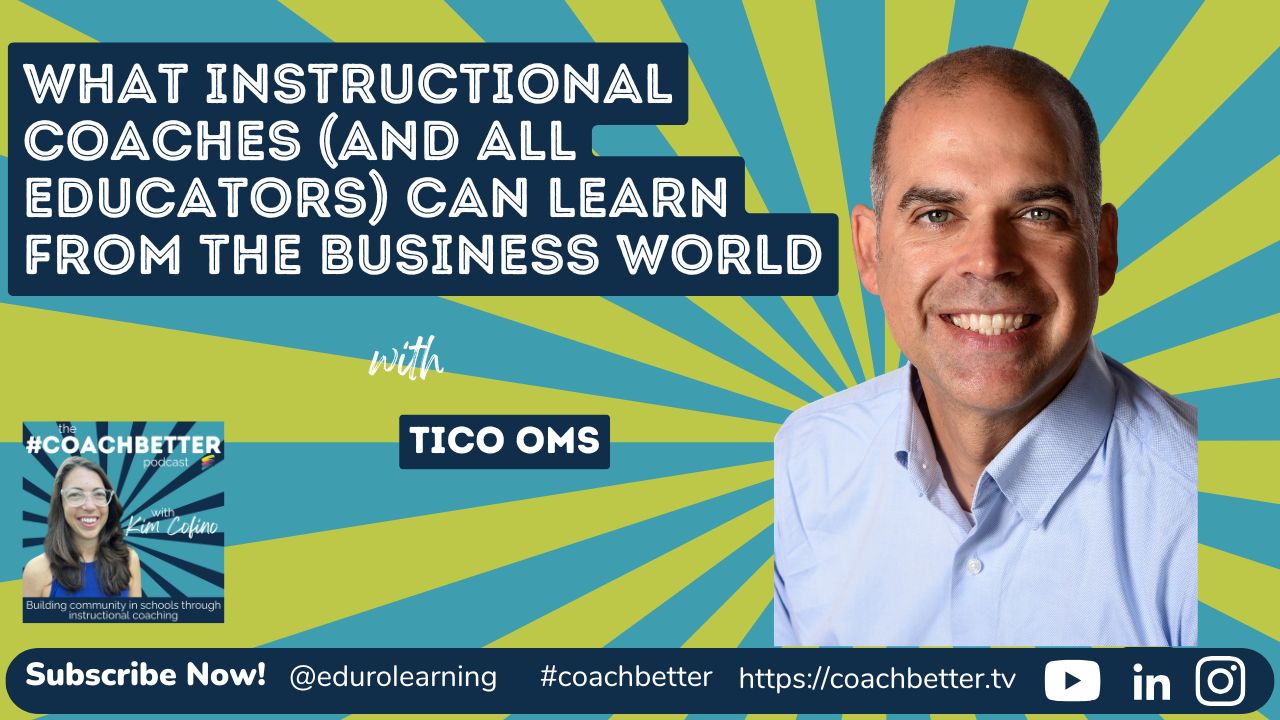
In this #coachbetter episode Kim talks with Tico Oms about what instructional coaches (and educators) can learn from the business world.
Tico is an educator, school leader, leadership coach as well as an Advisory Board member for the Association for the Advancement of Instructional Coaching in International Schools (AAICIS). But before all of his work in education, he was a corporate executive for Dell computers. With Tico’s business background (and his MBA), one of the things we’re often talking about are the things that educators can learn from the business world – and we promise these are relevant things that we actually need.
In their conversation they discuss:
- Why coaching is so powerful for schools – and the ways coaches can express that for senior leaders and boards
- What makes AAICIS special – and the business mindset that made it work
- Why instructional coaching in international schools has additional layers of complexity – and how coaches can leverage a key expectation in business settings to make the most of their partnership with principals
- What instructional coaches need to know about their informal leadership – and how to use those skills with their supervisor
- What leaders need to know about coaching – and how it aligns with all of their other responsibilities
Everything they talk about highlights the big picture or macro view of a coach’s role and the development of a coaching program – these are key skills that all coaches need to develop, and especially those working in highly transient environments like international schools.
Connect with Tico

Subscribe to #coachbetter via your favorite Podcast Player!



Show Notes
Please tell us about your journey as an educator:
Live in different places for 3-4 months at a time, as a leadership coach. Going back to the thing I enjoy most. Always been in and around trying to help others be good at whatever it is that they do. Journey has been full circle, teacher, school leader, leadership coach. Prior to teaching I worked in corporate, with an MBA
Some things about education can benefit from knowing the basics about business.
We have educators doing so much learning to build AAICIS because there is so little about business in education, that can be so beneficial for them.
As a member of the AAICIS board, and a strong advocate for coaching in schools, what makes you believe in the power of coaching?
International education is hard, and people feel so isolated, whether it’s SENIA, ISCA or AAICIS, I really believe in the power of communities getting together for common goals. Doing meaningful work with people I care about is so rewarding.
Instructional coaching has proven to be one of the best ways for people to move forward, not just in education. Coaching is taking off everywhere. We’ve always had it. Knowing how effective it is, we would be doing our students a disservice by not providing it.
It’s human, it’s about growth, it’s about risk taking, while feeling safe. It helps retention. If the teachers who want to learn and grow, they’re going to want to stay. If you get 20 teachers to be 10% better, that’s a return on investment – this is the way
Now that you’ve been working with AAICIS for two years, what really stands out to you? What makes AAICIS special?
The pace that a small group of people took to create AAICIS and how quickly another layer of volunteers came on board. A volunteer army of passionate people that are doing some really hard work to move the organization forward. There are some needs that are being met there: need for challenge and growth. People don’t get passionate about stuff that doesn’t work.
Coaches are forward looking people, they tend to be comfortable at the leading edge of best practice. We are representing best practice of instructional coaching; our white papers, principles of practice, conditions for success. Not only are we a community to fight the isolation, but we’re also the thought leaders.
What’s YOUR level of coaching mastery?
All coaches go through various stages of coaching mastery. Once you identify where you’re at, you can begin to build the skills needed to move to the next stage.
This quiz is based on real-life case studies compiled from years of working with coaches inside The Coach Certificate & Mentorship Program!
When you receive your results, you’ll also get your matching case study from the STRIVE Case Studies to see where you fit in the stages of coaching mastery.
Ready to tackle your challenges and move on to the next level in YOUR coaching practice?
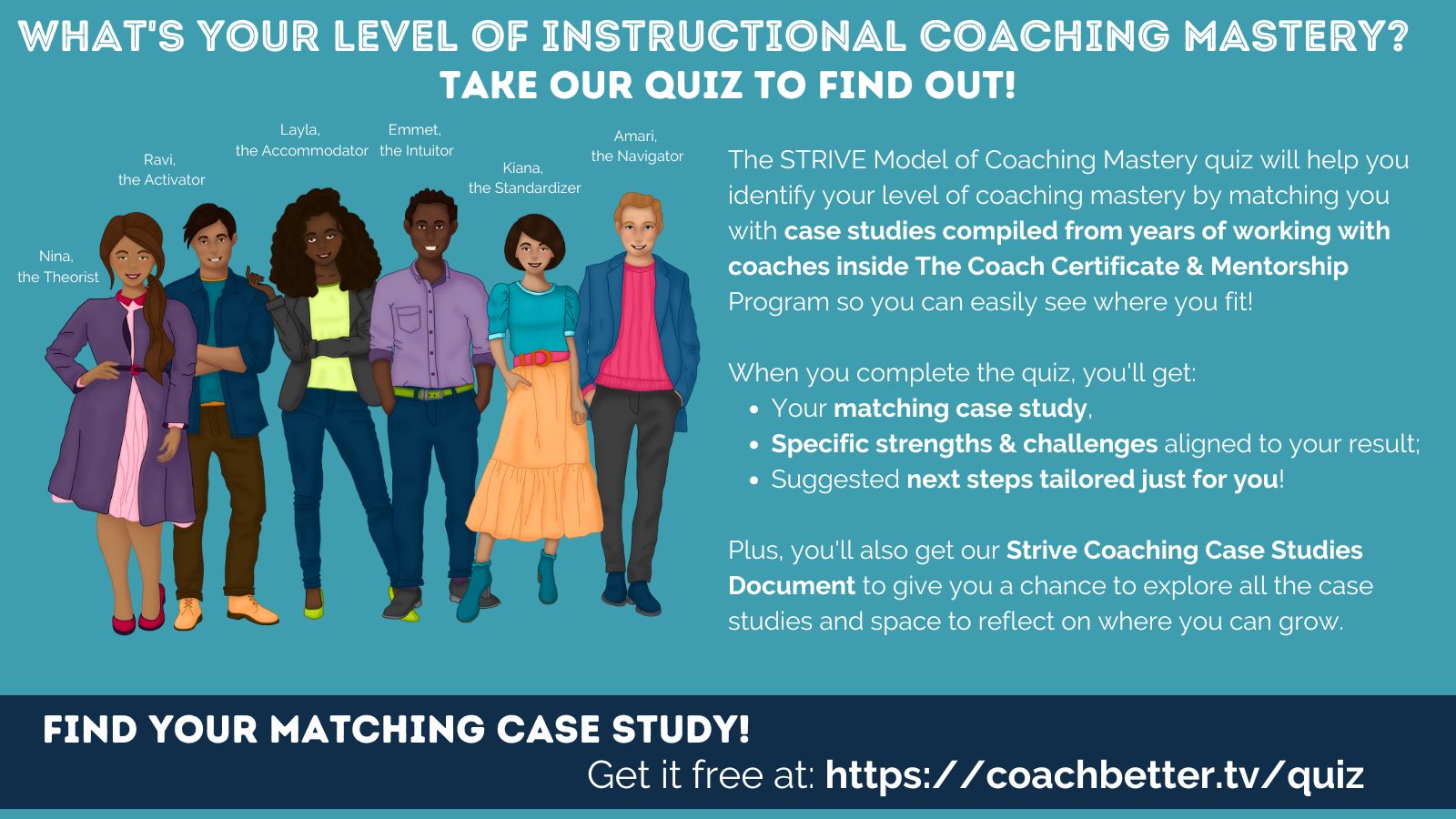
The STRIVE Model of Coaching Mastery quiz will help you identify your level of coaching mastery by matching you with case studies compiled from years of working with coaches inside The Coach Certificate & Mentorship Program so you can easily see where you fit!
When you complete the quiz, you’ll get:
- Your matching case study,
- Specific strengths & challenges aligned to your result;
- Suggested next steps for each stage;
Plus the Case Study Document includes:
- Case studies leveled by coaching mastery;
- A framework to identify essential stages of professional growth & key areas to focus on in your professional learning;
- Alignment with the THRIVE Model for a Successful Coaching Culture;
- Space for you to reflect & prioritize so you can take action immediately!
You’ll go straight to the Quiz, and get the Case Study Document via email.
Show Notes continued…
When you look back over the growth of AAICIS over the past two years, what do you think has made us grow / develop in this way?
The right thing at the right time. There is a need that’s being met. It’s a group of folks who strengths work with each other. We’ve already tackled some challenges that organizations face as they grow: moving from seat of the pants to more operational really quickly. If you don’t transition into more systems thinking. We’re full of people who like taking appropriate risks and challenges. We put together a virtual conference in year 2. People who are afraid of failure might not do well with us.
Get all of our AAICIS resources here!
Watch or listen to Tico’s previous episode here
Thinking about instructional coaching in our international school setting, what do you think are the specific challenges / complexities for us?
To be successful coaching needs an ecosystem that’s quite complex: putting together a culture of learning in a way that’s systematized and structured, over years. There are so many puzzle pieces. What makes it harder in international schools is that it feels like every school is inventing the wheel. Because we’re so isolated, and leaders are not so familiar with it, sometimes it doesn’t have the support it needs. If leaders aren’t familiar with the power of instructional coaching, they’re not as committed to it, if you haven’t been around it.
The leader needs to hire the right person to become the instructional coach. The skill sets are different. A really really good teacher isn’t necessarily a good coach. How do you build relationships, make people feel safe, etc. Then hire teachers who are actually curious. Coaches have to understand that leadership is really hard. There’s a dynamic that the decision maker is often the furthest from the issue, and knows the least about the context. The leader who has to make the decision often knows the least about this specific situation. We need to close the gap, so the smartest person in the room is the room. The instructional coach is instrumental in creating the vibe that my voice is important. Don’t take an animosity approach with your leader.
Instructional coaches have to get comfortable with the fact that you’re not a teacher anymore. Winging is not healthy and happy, and a luxury coaches can not engage with. Leaders can’t read your mind and you’re a coach, use that skillset to help your leaders help themselves.
What do you want out of the coaching program – and are you aligned there. Control the script.
In the business world: A boss hires me and I tell my boss what I need in my field of expertise. I took the initiative of what I needed. If you leave a vacuum, the leader is going to fill the vacuum. But YOU left the vacuum. Steve Jobs quote: “We don’t hire people to tell them what to do. We hire people to tell us what to do.”
We’ve been recently offering training for our team leads on stepping into their leadership, and we keep talking about how this applies to their work as coaches in schools directly. Can you highlight some of those key elements?
Realize that you have influence now. You have to start evolving from “I want everyone to like me” and shift to “I want to be respected”. To be respected you have to have values and beliefs that you hold on to. These are anchors that you have to hold on to. When people whine about something, you need to nip it in the bud.
Any leader can tell you their favorite teachers: the ones who can see the big picture. Instructional coaches have got to see the big picture, and support the school’s agenda in how they’re moving forward.
Conversation about decision ownership – what decisions can I make entirely, what decisions are yours (and hopefully I have a lot of input)?
If you’re a new instructional coach, head of student support services, etc, you don’t have a lot of power, you have to lead through influence. You have to lead up & out. You gotta go on a media tour – you have to meet them & build healthy relationships with them & figure out what meetings you need to be in. You need to focus on what the other people need, their goals. Learn what they need & then think about how instructional coaching can help them. Then you build alignment. It’s not like you’re asking for favors. You don’t have power, but anyone can gain influence. If you go through that approach, you’re going to get power and influence.
How can / should leaders support the work of instructional coaches? What can they do specifically?
You’ve got to have a healthy relationship with your coaches, you have to meet with them regularly. Can you make the time to meet weekly with your coaches in some format.
Give clarity into the reporting mechanisms. Sometimes instructional coaches don’t know who they report to. All the schools I’ve worked with on behalf of AAICIS are figuring out they need a matrix. Get granular.
Define the boundaries. Look at the conditions for success and understand what a good program looks like so you can work your way towards that.
Know some of the basics. Do you do child protection training, of course you do. You’ve got to do the same thing with instructional coaching.
What do you wish all leaders knew about instructional coaching?
Nothing is as important in the school as what is happening day in and day out with students, and the folks who lead that are the teachers. If you have a high performing teacher, those students are going to learn. Instructional coaches are going to raise the bar of the quality of teaching and learning.
Is there anything else you want to share with us?
I really respect instructional coaches, they’re in a tough spot: a little bit leaders, a little bit teachers, it’s a tough role. Having said all that, it’s a luxury to sit and complain and play the victim, there’s a lot of things you can do to move the program forward, there’s a lot of initiative you can take.
🔗 KEY LINKS FOR THIS EPISODE
- Getting Started as an Instructional Coach
- Join the Getting Started Waitlist
- Download all AAICIS resources here
⭐️ Episodes Referenced:
- Exploring the Complexities of Instructional Coaching in International Schools with Joellen Killion
- Tico’s first episode on the pod – from 2019!
Bonus! Watch the Spotlight Version on YouTube!
Ready to create a coaching culture that improves student learning and builds belonging?
Come learn with me!
I help educators, instructional coaches, informal or positional leaders work together to create thriving coaching cultures that improve student learning and build belonging.
Coaching programs based on the Thrive Model, with clarity, consistency and community, can create time and space for educators to feel seen, heard, respected and valued for the experts that they are – creating a sustainable system of educator professional growth that ultimately improves student learning.
For this kind of coaching to thrive we need to focus on both the micro view of your coaching practice and the macro view of your coaching program, so while you’re developing your individual coaching practice you’re also intentionally developing a sustainable coaching culture.
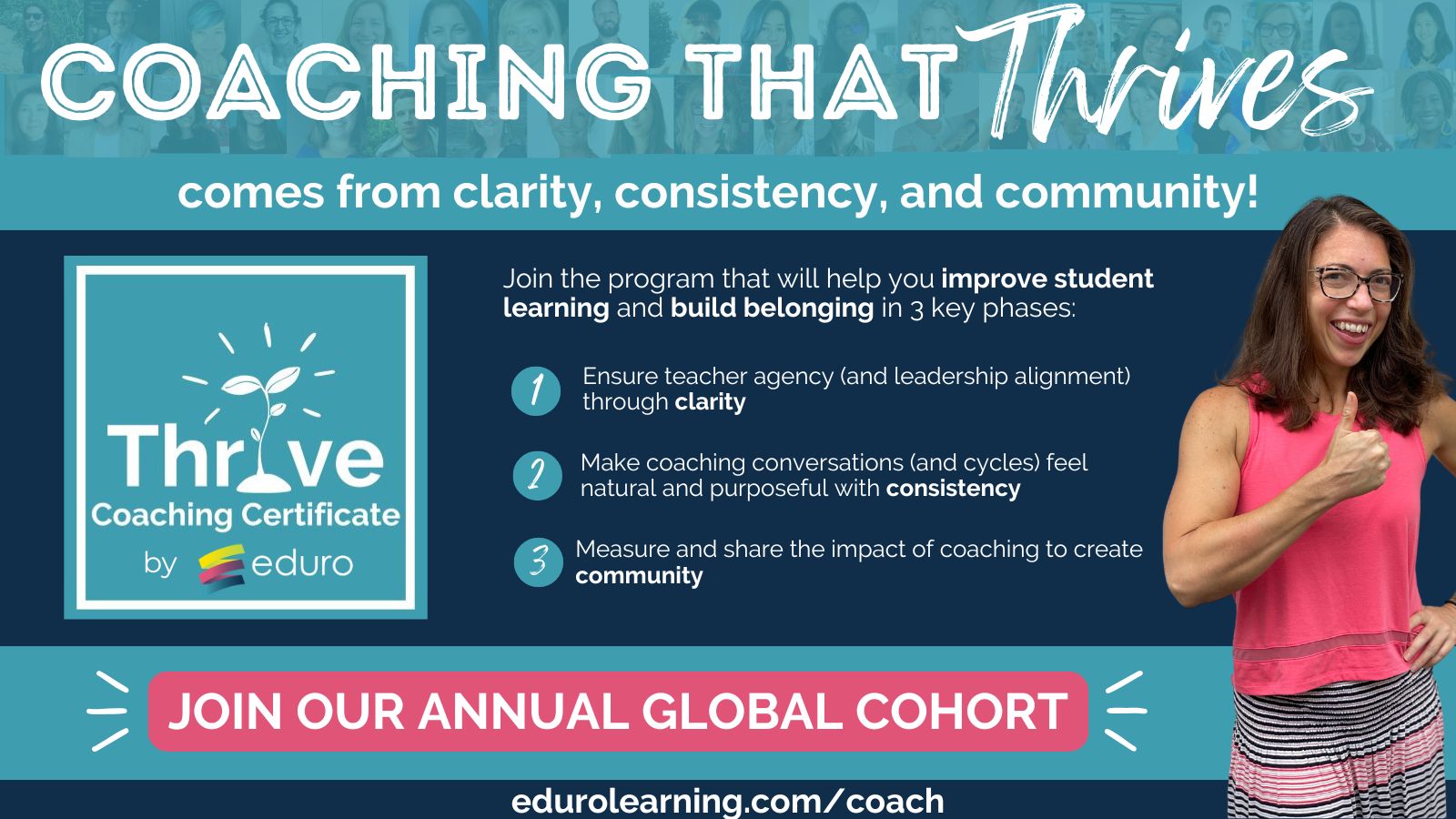
If you’re ready to build this kind of coaching culture in your school community, join us for the Thrive Coaching Certificate program!
Wherever you are in your coaching journey, we can support you!
When you’re ready, there are three key ways we can work together:
- in the Thrive Coaching Certificate,
- in a private mentoring package, or
- through work directly with your school.
Leave a comment below, or reply to any of my emails and let’s start a conversation to see how we can work together to create a thriving coaching culture in your school setting!
Connect with us!
- Subscribe to the podcast iTunes | Spotify | Stitcher
- Follow us on social media: Instagram | LinkedIn | YouTube
- Join our #coachbetter Facebook group
- Read more from Kim: all books & articles
- Explore our courses for coaches
Recent Comments