
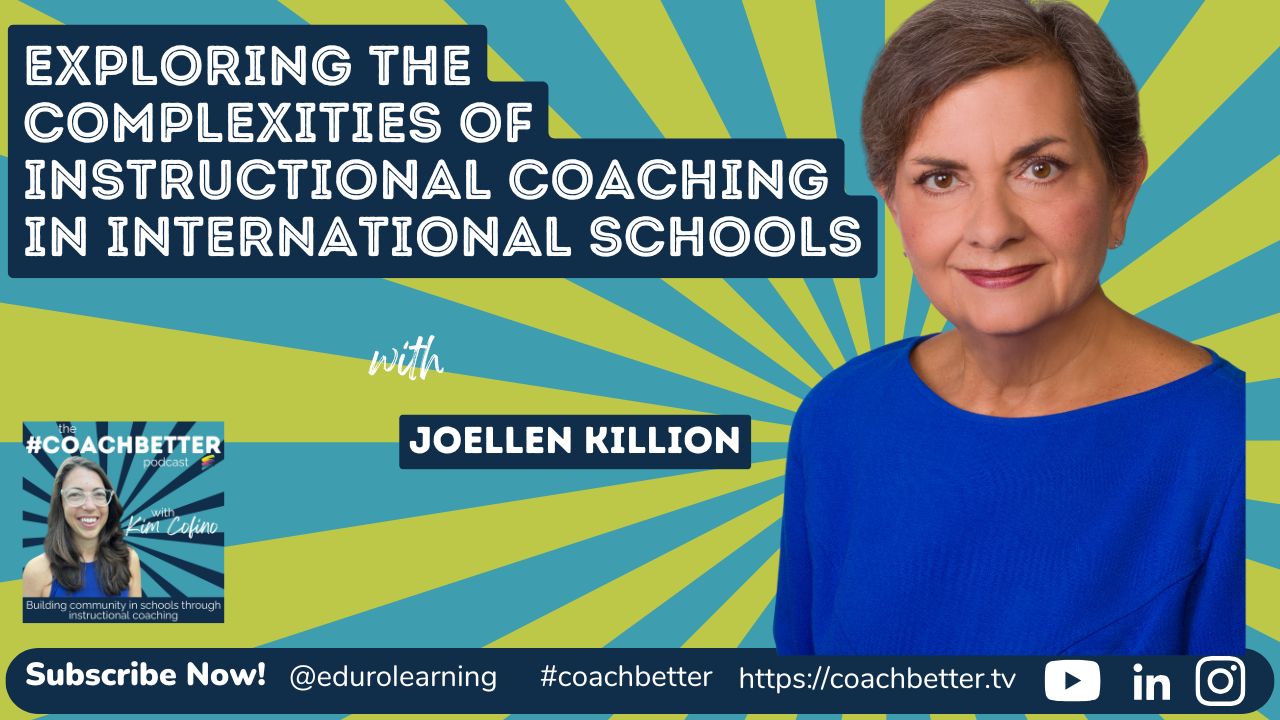
In this #coachbetter episode, Kim talks about the complexities of instructional coaching in international schools with her instructional coaching superhero, Joellen Killion.
This episode explores several complex topics, including:
- The additional layers of complexity around instructional coaching in international schools
- Where AI fits into the work of instructional coaches
- How leaders and coaches can work together to create the conditions for coaching success
- How coaching can support leading with agility
Connect with Joellen

Subscribe to #coachbetter via your favorite Podcast Player!



Show Notes
You have been on the AAICIS Advisory Board since the start, when you think about our work together, what makes instructional coaching in international schools unique?
On one hand, I see so many similarities between coaching in schools in a national setting (like in the US), like solo coaches working in schools and feeling isolated; the resistance to coaching is something that coaches in all contexts share; the notion of school culture and how it interacts with coaching is something that can either limit or advance coaching is also similar.
Despite these similarities I do see some significant differences:
- Extensive multicultural environments and all of the unique environments that simultaneously exist in international school settings. Coaches are called to work with teachers whose backgrounds, beliefs, identities, even their orientation to professional growth vary differently. Those differences cause coaches to need to have a deep expertise, cultural competence, to build relationships in different ways (based on mutual trust and respect that allows them to establish strong partnership agreements with people from different perspectives)
- Turnover of staff is higher than in most school settings. When staff is turning over so much, there’s a pretty easy tendency for coaches to be drawn into more mentoring roles than coaching roles and that can shift coaches focus away from that deep instructional focus.
- Belonging: in an international school setting, that factor is more complex because people are being transported into environments that may be new to them, they may not have ethe coping skills, expertise or self assurance or strong sense of identity for how they show up in a new culture
This is why it’s so crucial for coaches in international schools to have a community of members who share their same types of experience, their same types of context. That really gives them the opportunity to be open and honest with unique learning experiences tailored to their needs.
There is an underlying culture because of the nature and expertise of staff who are hired into those schools, there is some competitiveness that comes face to face with the desire to have collaboration, collective efficacy, there is a tension that exits. Many international school teachers may find working towards being their best is easier independently rather than independently
Really challenging for coaches, especially those who may not have much experience as a coach. SOmetimes this means that coaches go to whats easy (I’ll get you that resource) rather than identifying those unique tweaks to instruction
Given the rapid pace of change in the world (and in particular) developments with AI, how do you see coaching both fitting in, and supporting, educator wellness, belonging and collective efficacy?
Saw a news clip yesterday about humanoid robots and how they have become so sophisticated that they can turn on us. In coaching, I’m seeing a number of products that offer AI supported coaching, eg: analyzing transcript of classrooms and helping administrators writing feedback on transcript to minimize the workload of supervisory work.
The greatest opportunity AI gives us is to provide coaching support to more people, particularly where coaches are not available. I worked with a school district who had fiscal experts to determine the ratio of coaches to teachers, they determined it was 20:1. When we don’t have that number, there is an inequity of coaching support.
I believe every administrator deserves a coach. If an administrator is really committed to coaching they seek & use a coach for their professional growth.
There’s something about that interpersonal interaction, not mediated with AI, that allows a coaching client and a coach to really challenge some of the limiting assumptions and beliefs that hold people in their current state. Those beliefs and assumptions are difficult to uncover and even more challenging to unpack so that we know they are beginning to shift.
It’s easier to use some of the AI supported coaching to suggest a new strategy that might be used or recommend a resource, but the deeper work of coaching around assumptions and beliefs, I am not yet fully convinced that AI mediated coaching could help do that. It could help gather data, do data analysis.
We all talk about overcoming resistance, how do you bring people to AI supported coaching or virtual coaching if they’re reluctant. I don’t see how having those resources mitigates that problem. What data are being captures, where are the data going, who’s using those data.
I am a strong proponent of coaching as a vehicle for extending collaboration and collective efficacy in a school, I believe that happens when real people interact with each other, particularly when coaches work with teams. I’m not sure how AI can interact with that right now.
Middle ground: we can use AI captured data, observed practices, and let AI help conduct initial analysis, but then the part about the deep metacognitive reflection requires a facilitator of that thinking is the coach
AI can help us if the outcome we’re seeking is information transfer. If the outcome is to shift how people are thinking, there’s a whole different approach – it’s not just giving people information, it’s digging into what they think and how they think. They’re very personalized and unique to the conversation that exists to the coach and the client at the moment – they’re not prescribed, or programmable to the degree that a human conversation can be.
What’s YOUR level of coaching mastery?
All coaches go through various stages of coaching mastery. Once you identify where you’re at, you can begin to build the skills needed to move to the next stage.
This quiz is based on real-life case studies compiled from years of working with coaches inside The Coach Certificate & Mentorship Program!
When you receive your results, you’ll also get your matching case study from the STRIVE Case Studies to see where you fit in the stages of coaching mastery.
Ready to tackle your challenges and move on to the next level in YOUR coaching practice?
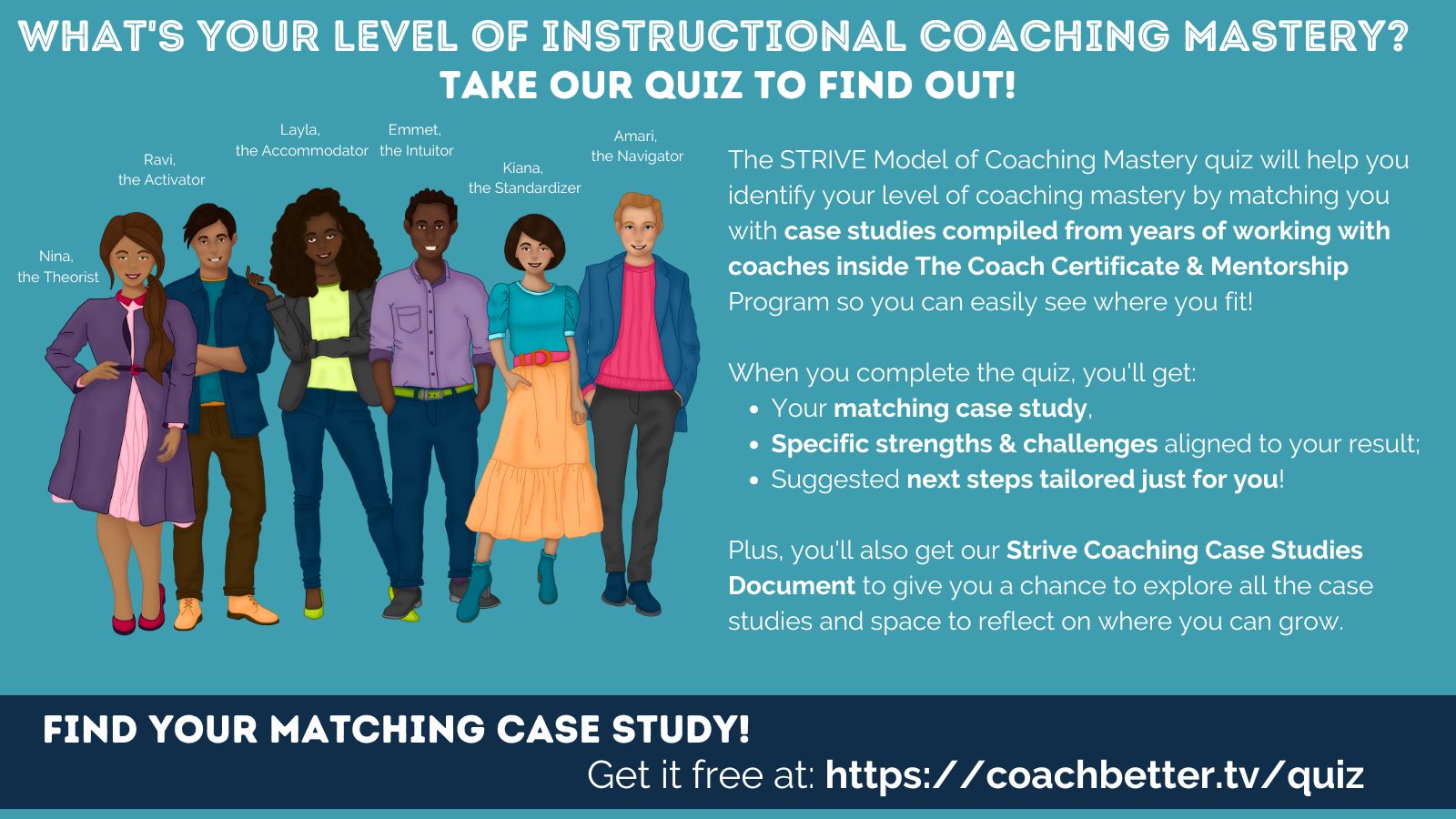
The STRIVE Model of Coaching Mastery quiz will help you identify your level of coaching mastery by matching you with case studies compiled from years of working with coaches inside The Coach Certificate & Mentorship Program so you can easily see where you fit!
When you complete the quiz, you’ll get:
- Your matching case study,
- Specific strengths & challenges aligned to your result;
- Suggested next steps for each stage;
Plus the Case Study Document includes:
- Case studies leveled by coaching mastery;
- A framework to identify essential stages of professional growth & key areas to focus on in your professional learning;
- Alignment with the THRIVE Model for a Successful Coaching Culture;
- Space for you to reflect & prioritize so you can take action immediately!
You’ll go straight to the Quiz, and get the Case Study Document via email.
Show Notes continued…
You have offered several sessions for us on how coaches and leaders can work together to create the conditions for coaching success, particularly at the start of the year, what are a few highlights that coaches and leaders can think about together?
The most important thing is the a coach and school leaders take time to be thoughtful about a few really critical issues:
- Clarity of purpose of coaching and understanding why the coach exists: Why coaching? What is the purpose of coaching in this school? Why was a coach hired? (to strengthen student performance through strengthening instructional quality)
- Setting goals and outcomes that are aligned with that purpose so we have a way of monitoring and measuring whether coaching is working the way we expected coaching to be working, we can gather data about the coach and the coaches work, and data about administrator support and staff engagement
- What is your expectation of staff members in the school regarding coaching – is it required, is it voluntary? Eg: not requiring coaching but expecting – when we hold high expectations we see better results vs mandating coaching which will get people to engage but not with an open mind. Hold high expectations that every staff member is engaging with the coach that is aligned with the goals outcomes and purpose and produces results for students
- Roles: helping a coach know what roles (10 roles of coaches) that are most closely aligned to the purpose, goals outcomes and expectations
- Ongoing monitoring: what data will be collected & how will you use those data to continue to upgrade the coaching program.
Coaches are hesitant because they assume the administrator is going to do this work – which is why we talk about a partnership agreement – but this is even more important – these are programmatic questions. These are questions that have to do with coaching in general and extend beyond the partnership agreement. It is a bold coach that will take the step to walk in with this segment, sit down with the administrator and say, success in coaching requires these things, let us work together to reach agreement. That school administrator will want the coach’s assistance because coaching is new to them too.
We wrote an article together about how coaching can support leading with agility, how does coaching increase a leader’s capacity to be an effective instructional leader? (Lead with Agility by Embracing Instructional Coaching (p 61-67) by Kim Cofino & Joellen Killion)
The whole notion of having a partner to process with, a partner who sees what’s occurring in the school in a way that might be different from what the administrator is seeing, there might be more insight on the part of a coach. Having a partner who brings a perspective is one way a coach can add value.
Phil Hellenger and Jo Murphy define instructional leadership with 4 critical responsibilities:
- Setting a vision, high expectations and goals
- Supervising and evaluating instruction
- Coordinating the curriculum
- Monitoring student progress
If I know those are the 4 critical responsibilities of school leaders, there are 3 there that align with coaching work
- Setting a vision, high expectations and goals
Using the strategic plan as a basis for what I work with teachers on, or in terms of setting my goals, priority and focus
- Coordinating the curriculum
Coaches are constantly using the curriculum as they’re interacting with teachers, helping teachers think about how curriculum, instruction and assessment are intertwined. They use those three pillars to think about how to have reflective conversations with teachers. They support administrators by stepping in sharing that work .
- Monitoring student progress
Not that they’re taking away the responsibility from the leader, but the savvy admin is partnering with the coach to take on more, do more, accomplish more and do more for students because now we have a partnership working together, which gives the leader more flexibility to shift among these responsibilities.
A partner in anything makes our work so much easier. I’m a better thinker, planner, critic when I have a partner to bounce ideas off of, I can really dig more deeply into the why I’m doing things, what do I believe rather than just the mundane, get it done & tick the box.
We raise the importance of people by sharing through transparency of practice what coaching is among every member of the school community & advocate their use more and more in the interactions we have. There’s no reason why someone who’s in a secretary role can’t use coaching skills when a parent calls who’s upset about something. There’s no reason why our custodial staff can’t use coaching skills when trying to help a teacher figure out what’s needed to make their classroom safer than it is at the moment. There’s no reason why students can’t be using coaching skills with each other.
If our coaches are holding the notion that I’m the only one who knows how to coach, and holds close to the vest, then we’re missing an opportunity to deepen access to coaching and a coaching culture in our school. I’d encourage all coaches to share what they’re doing and why they’re doing it, explain their practices and invite others to learn with them, because that’s what builds that true community of deep caring, interdependence commitment to continuous reflection and growth in our schools and it not just for the staff, but for students as well.
🔗 KEY LINKS FOR THIS EPISODE
- Getting Started as an Instructional Coach
- Register for the LIVE Workshop: New to Coaching
- Join the Getting Started Waitlist
- Lead with Agility by Embracing Instructional Coaching (p 61-67) by Kim Cofino & Joellen Killion
- Previous episodes with Joellen: What Makes Coaching Work? & Essential Skills for Emerging Leaders with Chris Bryan, Heather Clifton, Joellen Killion, Lynn Simmons, and Cindy Harrison
Bonus! Watch the Spotlight Version on YouTube!
Ready to create a coaching culture that improves student learning and builds belonging?
Come learn with me!
I help educators, instructional coaches, informal or positional leaders work together to create thriving coaching cultures that improve student learning and build belonging.
Coaching programs based on the Thrive Model, with clarity, consistency and community, can create time and space for educators to feel seen, heard, respected and valued for the experts that they are – creating a sustainable system of educator professional growth that ultimately improves student learning.
For this kind of coaching to thrive we need to focus on both the micro view of your coaching practice and the macro view of your coaching program, so while you’re developing your individual coaching practice you’re also intentionally developing a sustainable coaching culture.
If you’re ready to build this kind of coaching culture in your school community, join us for the Thrive Coaching Certificate program!

Wherever you are in your coaching journey, we can support you!
When you’re ready, there are three key ways we can work together:
- in the Thrive Coaching Certificate,
- in a private mentoring package, or
- through work directly with your school.
Leave a comment below, or reply to any of my emails and let’s start a conversation to see how we can work together to create a thriving coaching culture in your school setting!
Connect with us!
- Subscribe to the podcast iTunes | Spotify | Stitcher
- Follow us on social media: Instagram | LinkedIn | YouTube
- Join our #coachbetter Facebook group
- Read more from Kim: all books & articles
- Explore our courses for coaches
Recent Comments