
Let’s talk about why coaches need to think like leaders.
Eek. You became a coach because you want to be spending your time coaching. Why should you have to start thinking like a leader? And what does that even mean?
First: reality check: whether you want to be or not, if you’re in an instructional coaching role, you are an informal leader in your school. You are, by definition, no longer a classroom teacher. You are, by default, operating in a space where you have more interaction with leaders than most classroom teachers, and that means you likely have more information about school or divisional goals. You are, by definition, likely working with your Director of Teaching and Learning to plan professional learning and support curriculum development.
So, here you are, an informal leader – maybe even without realizing it.
That probably means you’re expected to:
- lead without being a formal leader (ie: you have no positional power);
- see the big picture, often without having all the puzzle pieces;
- inspire your colleagues without having a class of your own; and
- be the connection between teachers and leaders, without really being part of either team.
And you might not have had any idea that was coming when you accepted the position. I promise, you’re not alone. This is exactly what so many of my graduates in our Getting Started as an Instructional Coach course say when they finish the course.
Here’s a few examples of what they say:
“Not only do you have to develop skills as a coach, but you have to develop the skills of a leader.”
“We’re having to think like leaders AND having to upskill them to what the role is at the same time, it’s a big shift. This course allowed me to process why my previous coaching-type experience fell apart, without realizing it. I would have loved this course 5-10 years ago, but I’m glad I’m here now. “
They came to the course to learn how to coach – and of course we do a lot of that within the course too. But a big chunk of the course is about understanding the macro view of how coaching fits within the school systems. (We talked about this on a few previous episodes of the show – I’ll link those episodes up here & in the show notes for you).
This means understanding that:
- A coaching culture is unlikely (almost impossible to grow) if the conditions needed are not present (trust, relationship building, psychological safety, growth mindset, risk taking).
- If teachers don’t know why or how coaching will support them in developing their practice, they’re not going to choose to engage in the coaching process.
- If your time, as an instructional coach, is filled with exam supervision, field trip chaperone, substitute cover, duties, administrative tasks and “other projects as assigned” and you don’t have any time to actually coach, there will be too many barriers for you to actually do any coaching
- If you’re not able to do the coaching for any of the above reasons, it’s going to appear that coaching is not working – which is how and when we see coaching programs disappear.
Do you see how you need to think like a leader – even if all you want to be doing is the coaching?
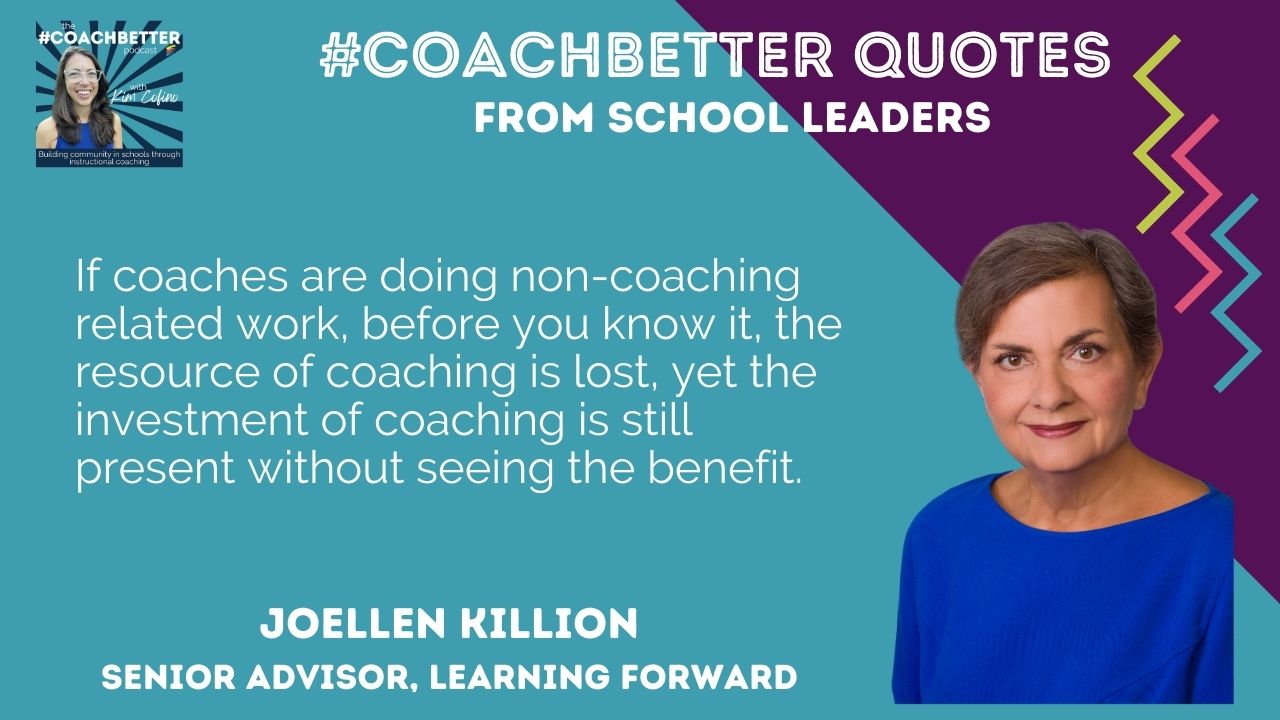
Thinking like a leader means that you are intentional about both developing your awareness of, and taking action, at the macro level – the big picture systems that create the conditions for coaching success – within your sphere of influence of course (we have another episode about the systems and structures and spheres of influence, which I’ll link for you here & in the show notes).
This reminds me of a great question I was asked by a coach, on a discovery call, who was getting ready to join us for the Thrive Coaching Certificate. They said:
“Everything is going great with our coaching program. We don’t need help with the program, what we need help with is the structural challenges that we’re facing around our leadership and what our responsibilities are and how we take best advantage of the time we have.”
That’s the macro view in a nutshell.
Program design isn’t just about what kind of coaching you do, or how you take action as a coach. It’s about ensuring that you’re advocating for (and doing as much as you can within your sphere of control and influence) to create the conditions for coaching to be successful.
This is so easily overlooked, because we assume that once we’ve been hired to coach, these conditions must already be in place. But in so many situations, there are gaps where there are pieces missing. And those gaps, those missing pieces get in the way of you actually being able to do the coaching work you were hired to do.
What’s YOUR level of coaching mastery?
All coaches go through various stages of coaching mastery. Once you identify where you’re at, you can begin to build the skills needed to move to the next stage.
This quiz is based on real-life case studies compiled from years of working with coaches inside The Coach Certificate & Mentorship Program!
When you receive your results, you’ll also get your matching case study from the STRIVE Case Studies to see where you fit in the stages of coaching mastery.
Ready to tackle your challenges and move on to the next level in YOUR coaching practice?
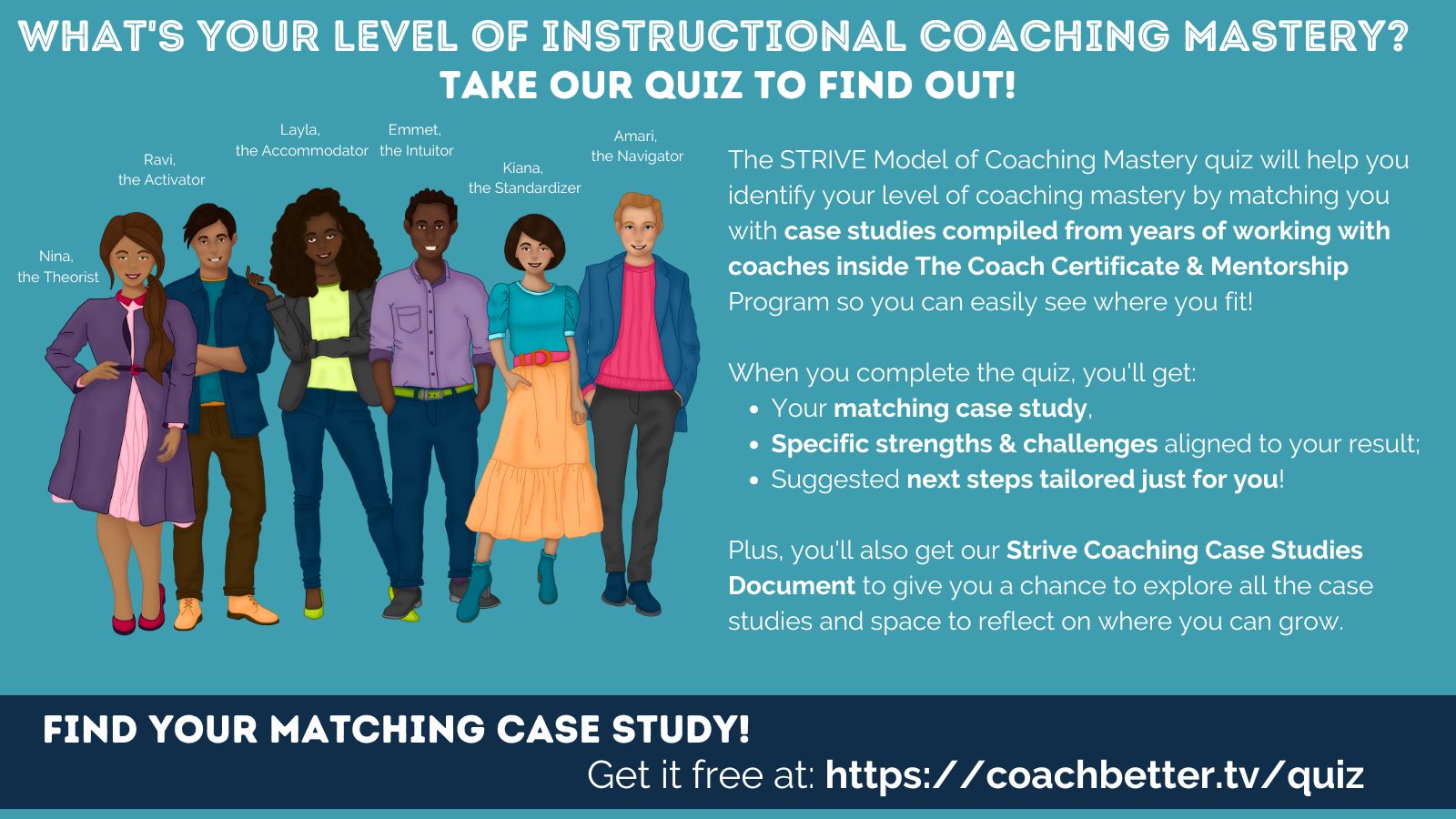
The STRIVE Model of Coaching Mastery quiz will help you identify your level of coaching mastery by matching you with case studies compiled from years of working with coaches inside The Coach Certificate & Mentorship Program so you can easily see where you fit!
When you complete the quiz, you’ll get:
- Your matching case study,
- Specific strengths & challenges aligned to your result;
- Suggested next steps for each stage;
Plus the Case Study Document includes:
- Case studies leveled by coaching mastery;
- A framework to identify essential stages of professional growth & key areas to focus on in your professional learning;
- Alignment with the THRIVE Model for a Successful Coaching Culture;
- Space for you to reflect & prioritize so you can take action immediately!
You’ll go straight to the Quiz, and get the Case Study Document via email.
And the especially challenging part is that it’s entirely possible that no one knows that there are gaps in the first place! Instructional coaching is new enough (particularly to international schools) that we don’t have consistency across programs or clear program development stages designed for an international school context (something we’re working on through AAICIS right now). We don’t have existing models for how to ensure all the pieces are in place like we do for other areas of schools like I mentioned in a previous episode this season:
- We know after school athletics needs coaches and a space to train.
- We know ongoing curriculum development needs curriculum review cycles.
- We know hiring teachers requires a process for recruitment.
But we don’t have an established process for building a coaching culture – that’s why I designed the Thrive Model and why I created the Thrive Coaching Certificate – to provide educators and schools who want to build a coaching culture a pathway to follow – and a guide to understand which pieces might be missing right now. (And if that sounds like the support you need right now, head over to edurolearning.com/coach to get on the waitlist for our next global cohort today!)
But the reality is, especially in schools that aren’t using the Thrive Model, for it to be quite common that coaches are hired, but there isn’t actually a coaching program in place to enable them to be successful – all without anyone even realizing there’s something missing.
This puts the coach in an especially difficult situation – something is not working, usually at the systems level, but for all intents and purposes it looks like the coach isn’t doing the work. And unfortunately the outcome of this situation is either: deciding coaches aren’t busy enough and giving them enough unrelated tasks that they don’t have any time to coach anyway, or deciding that coaching isn’t work and either letting go of coaches or not re-hiring when they leave.
Definitely NOT the place you want to be, right?
So what do you do? How do you fix it?
You need to learn how to build, develop or refine your coaching program.
This often looks like learning how to…
- better work with your school leaders
- align your vision of coaching with the expectations of school leaders
- gaining clarity about what is leadership work and what is coaching work
- advocate for time and space within the school day for teachers to be coached
- defining (or redefining) your workload so that you have the time to do the coaching
- learning how to articulate the impact that being assigned “other duties” (while they may be important) has on the coaching program
- collect, analyze and share coaching data so your work actually has an impact on student learning & teacher professional growth.
This is why coaches need to think like leaders. It’s hard to be successful in a program or an environment that isn’t set up for you to be successful. So even if you’re in an established program (and even more so if you’re building from the ground up), you need the three elements of the Thrive Model:
- Clarity: about what coaching is and is not; so you can build a shared understanding within your school community,
- Consistency: in the development and implementation of consistent coaching practices so teachers engage consistently & coaching serves its purpose of improving student learning, and
- Community: to build a coaching culture that gets embedded within the culture of the school.
And you need to start uncovering what might be missing – so you can start filling in those missing gaps. Here’s how they might be showing up for you:
- If you feel like you’re doing a lot of work, but you’re not seeing a lot of impact, you likely have a consistency gap.
- If you notice that teachers are reluctant to be coached and it’s hard to find coaching partners, you likely have a clarity gap.
- If you’re finding that coaching is stuck at the 1:1 level and it’s challenging to scale up to work with groups or teams, it’s likely that you have a community gap.
- If one of those sounds like you, you’re not alone.
- If you never noticed it before today, you’re not alone.
These are so easy to miss or to misdiagnose. When we start coaching, we don’t realize we need to think like leaders. We might not even realize that coaches are leaders in their school communities. That’s why I created the Thrive Model, the Thrive Coaching Certificate and Getting Started as an Instructional Coach. I’ve been through all of this myself, and I know how confusing it can be. I want to make it so much easier for you! And that’s what we can do together in a course! When you join me for Getting Started as an Instructional Coach you’ll understand why coaches need to think like leaders, how to pay attention to the red flags you might otherwise miss, and how to start taking action (just like my client Ula who was featured on the podcast a few weeks ago).
WATCH THE VIDEO OR LISTEN TO THE PODCAST
🔗 KEY LINKS FOR THIS EPISODE
- Getting Started as an Instructional Coach
- Join the Getting Started Waitlist
- Case Study: Peeking behind the curtain into an instructional coaching role with Ula Konczewska
Ready to create a coaching culture that improves student learning and builds belonging?
Come learn with me!
I help educators, instructional coaches, informal or positional leaders work together to create thriving coaching cultures that improve student learning and build belonging.
Coaching programs based on the Thrive Model, with clarity, consistency and community, can create time and space for educators to feel seen, heard, respected and valued for the experts that they are – creating a sustainable system of educator professional growth that ultimately improves student learning.
For this kind of coaching to thrive we need to focus on both the micro view of your coaching practice and the macro view of your coaching program, so while you’re developing your individual coaching practice you’re also intentionally developing a sustainable coaching culture.
If you’re ready to build this kind of coaching culture in your school community, join us for the Thrive Coaching Certificate program!

Wherever you are in your coaching journey, we can support you!
When you’re ready, there are three key ways we can work together:
- in the Thrive Coaching Certificate,
- in a private mentoring package, or
- through work directly with your school.
Leave a comment below, or reply to any of my emails and let’s start a conversation to see how we can work together to create a thriving coaching culture in your school setting!
Connect with us!
- Subscribe to the podcast iTunes | Spotify | Stitcher
- Follow us on social media: Instagram | LinkedIn | YouTube
- Join our #coachbetter Facebook group
- Read more from Kim: all books & articles
- Explore our courses for coaches
Recent Comments