
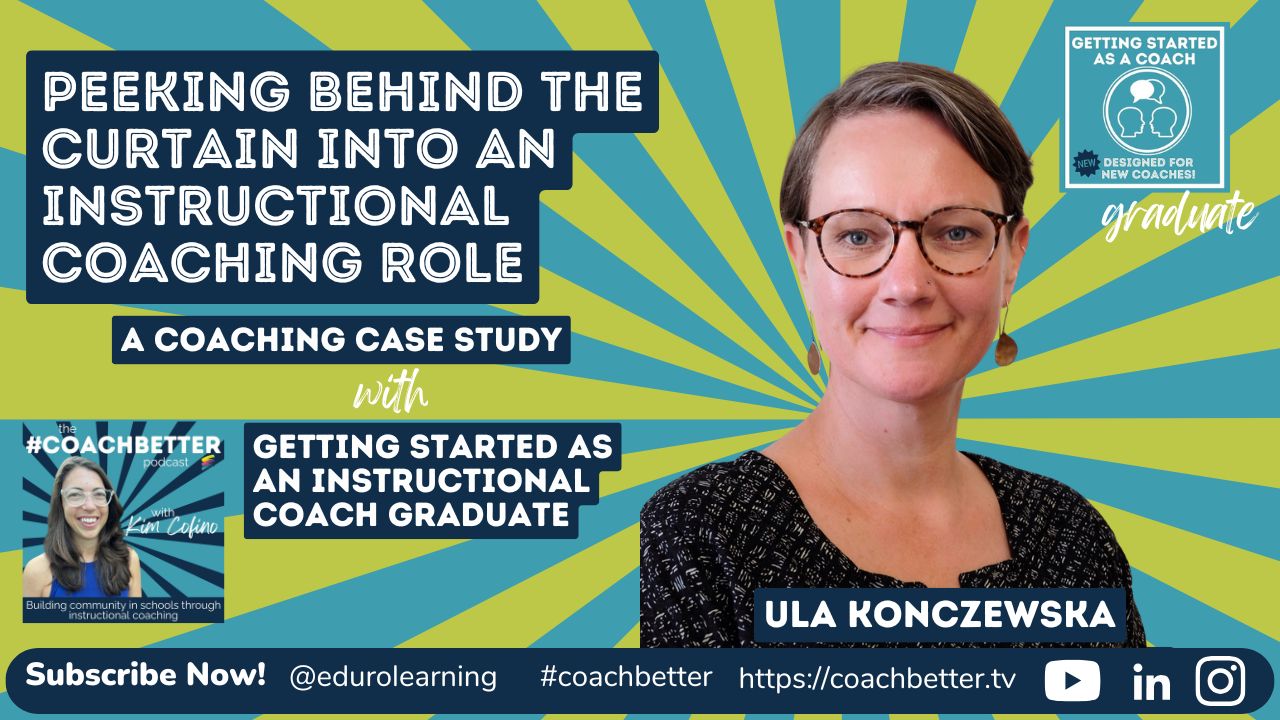
In this #coachbetter case study episode with one of Kim’s Getting Started as an Instructional Coach graduates, Ula Konczewska, they peek behind the curtain into an instructional coaching role.
In this episode Kim and Ula talk about:
- How Ula first discovered coaching & what she thought about it
- How working with an instructional coach supported her professional growth as a classroom teacher
- Things that make coaching work for her as a classroom teacher
- What classroom teachers expect or need from their instructional coach
- Why she joined Getting Started as an Instructional Coach – and what she learned in the course
- How she feels about stepping into a coaching role now
- Her advice for other educators
Connect with Ula

Subscribe to #coachbetter via your favorite Podcast Player!



Show Notes
Please tell us about your journey as an educator.
I stumbled into education, in my early 20s. Moved to Prague for an adventure, got a job at a PreSchool as a teaching assistant, stepped into KG, and discovered I loved it. Went back to the US, got my masters in Elementary Ed. By lucky coincidence, my first job was teaching at Greenwood Friends school, K-8 school, co-teacher in a multi age classroom. Everything that I’ve learned about education, came from that school. Went back international, moved to Bulgaria, India, Dhaka, back to Bulgaria.
Congratulations! You just got hired as an instructional coach! What do you think helped you get your new job?
Something that I’ve been thinking about for the past few years, because of the coaching experiences I’ve had as a teacher with wonderful coaches. At Dhaka I did some PDs for my colleagues, it seemed fun & I got positive feedback. I love research and reading and this seemed like a nice way to channel all of these curiosities.
When you first discovered coaching, what did you think about it?
First time I encountered coaching was in Sofia. One of my colleagues stepped into the newly made role. It felt luxurious, you have this person who is ready, has time, has resources and wants to support you. Moved to Chennai, where they have a more established coaching program. My most successful experiences started with a hallway conversation with the coach, who is being open to listen for the things I might need as a teacher and follows up. Always felt very natural.
After going through the course, I know it was natural, but it was also strategic in the way that they’re always looking for what I might need as a teacher.
As a teacher, how has working as an instructional coach supported your professional growth?
One that stands out, as a grade level team, in a team of 6. We were thinking of changing one of our literacy topics, it didn’t feel culturally responsive. The coach was just there, listening, and a couple of days later she shared a revised version of the planner, which was perfect for what we wanted. It was great because it was a team effort, she knew we needed something concrete to get us started. She started the planner, it wasn’t complete
In what ways does coaching work for you as a classroom teacher?
It’s about being bite sized – exactly what I needed, but not too much, feels achievable and something that can be refined, and then it needs to be transferable.
Feeling achievable is so important because it feels like something I can actually do in limited time.
What’s YOUR level of coaching mastery?
All coaches go through various stages of coaching mastery. Once you identify where you’re at, you can begin to build the skills needed to move to the next stage.
This quiz is based on real-life case studies compiled from years of working with coaches inside The Coach Certificate & Mentorship Program!
When you receive your results, you’ll also get your matching case study from the STRIVE Case Studies to see where you fit in the stages of coaching mastery.
Ready to tackle your challenges and move on to the next level in YOUR coaching practice?
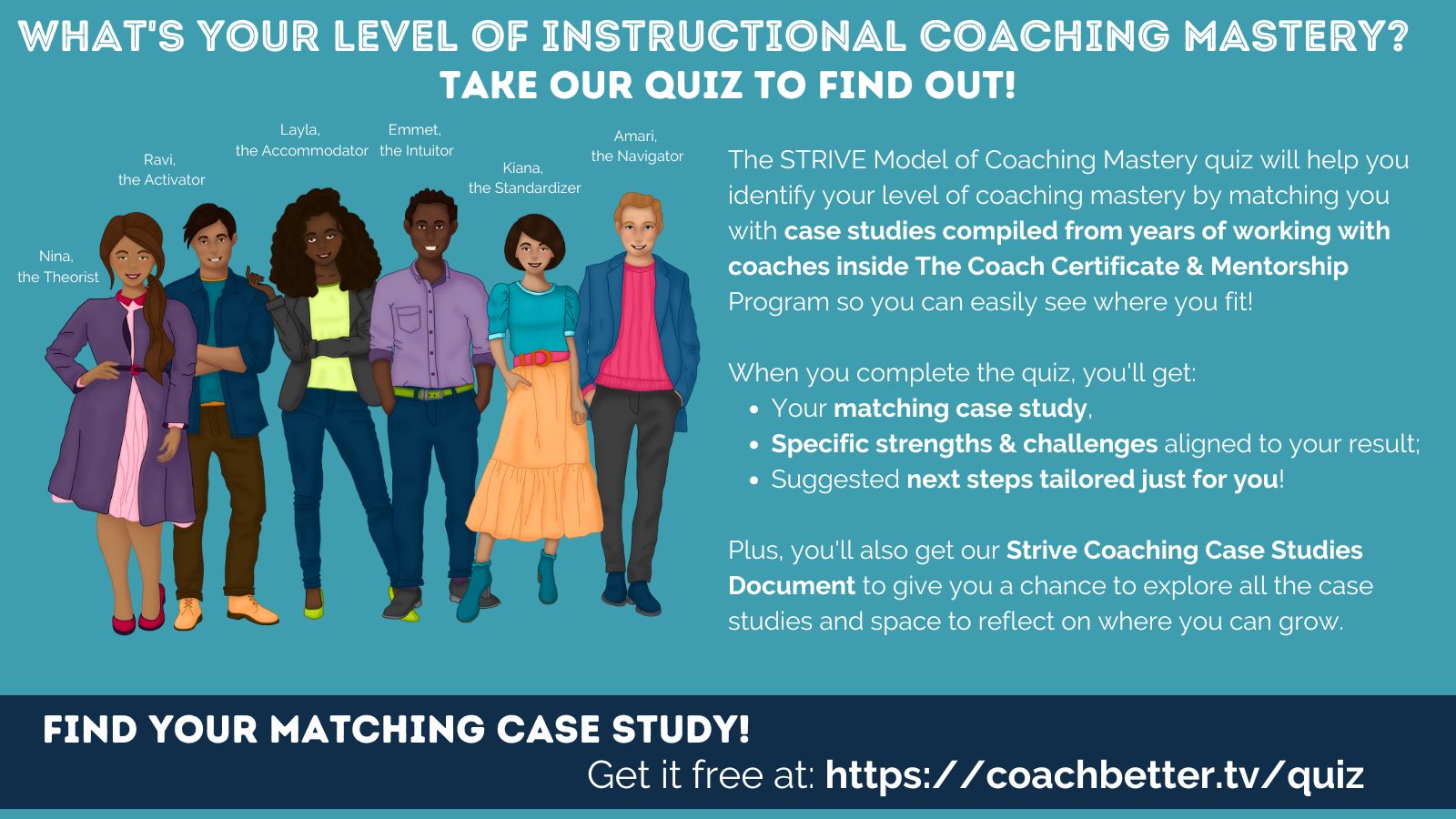
The STRIVE Model of Coaching Mastery quiz will help you identify your level of coaching mastery by matching you with case studies compiled from years of working with coaches inside The Coach Certificate & Mentorship Program so you can easily see where you fit!
When you complete the quiz, you’ll get:
- Your matching case study,
- Specific strengths & challenges aligned to your result;
- Suggested next steps for each stage;
Plus the Case Study Document includes:
- Case studies leveled by coaching mastery;
- A framework to identify essential stages of professional growth & key areas to focus on in your professional learning;
- Alignment with the THRIVE Model for a Successful Coaching Culture;
- Space for you to reflect & prioritize so you can take action immediately!
You’ll go straight to the Quiz, and get the Case Study Document via email.
Show Notes continued…
As a teacher, what do you expect or need from your instructional coach?
I want my coach to know me as a teacher, what are my values, what do I believe. I want to be seen. I want what we’re working on to be rooted in my values.
You need to be in the classroom, seeing the teacher work with the students. In a non-evaluative situation so the teacher can be themselves. Building those relationships early on, at the beginning of the year. Where you can show up in a way that’s non threatening.. Looking for little bits of information that will tell me about what they value. Have conversations where I can clarify.
When you joined Getting Started as an Instructional Coach, what were you thinking about in terms of your own growth?
Because I experienced it, I could figure out what the coaches were doing, but I could only see the front, and I was curious about what was happening behind the curtain. When I joined I was really just thinking about having coaching conversations and coaching cycles. But after I joined the course, even just looking at the syllabus, and coaching conversations is one chapter, but there are other chapters in the book.
What did you uncover / learn in the course?
It starts with building relationships, the course dug deeper into what that looks like, how we can be intentional and strategic about it. Thinking about equity, to make sure everyone at school feels like they can approach you. The bigger piece was thinking of yourself as a leader, this informal leadership, what does that mean in the bigger system. Being the middle person between the leaders and teachers. The big piece was how much advocating you need to be doing – in a positive way – because the work can be invisible, to make sure we keep track and celebrate what we’re doing
How do you feel about stepping into a coaching role now?
It still feels like a lot because I’m aware of all the pieces, I’m appreciative that I have all those pieces. When I encounter a new situation, I can understand what’s happening here. It might be about me being a leader, or me needing to communicate better. I feel aware of what the different pieces are. I can be more proactive, or when I encounter
What are you excited about?
Being in teachers’ classrooms at different levels. To be able to see the whole school, PreK to 12. To have that systemic view. To be able to look at school mission, vision and see what we’re hoping for as a whole school and understand where everyone falls. Being the communicator with the teachers about that bigger view.
What advice do you have for other educators considering stepping into a coaching role?
Looking for opportunities where you can test out whatever you’re curious about (lead PD, lead a team meeting), ask for feedback.
Having conversations with people who might be doing that job at your school, what they appreciate about the job, what are the challenges.
Having coaches as mentors.
What advice do you have for other educators considering being coached?
It’s this luxury of having the attention, skills and resources of the one person who is there for you. They’re ready to support you in whatever shape or form that you would like to be supported. It would be a shame to not take that opportunity. As teachers, we’re always working on things, too often we think we can handle it on our own, so having that extra person that can help you figure one or two things out, so you can even transfer it to future things, is so invaluable. Get to know the coach, on a personal level. What was powerful, is that I did have good relationships before we started.
🔗 KEY LINKS FOR THIS EPISODE
- Getting Started as an Instructional Coach
- Register for the LIVE Workshop: New to Coaching
- Join the Getting Started Waitlist
- Other Case Study Episodes with Getting Started Grads: Angela Mee Lee, Ana Cristina Lopez, Andrea Goodrich
Bonus! Watch the Spotlight Version on YouTube!
Ready to create a coaching culture that improves student learning and builds belonging?
Come learn with me!
I help educators, instructional coaches, informal or positional leaders work together to create thriving coaching cultures that improve student learning and build belonging.
Coaching programs based on the Thrive Model, with clarity, consistency and community, can create time and space for educators to feel seen, heard, respected and valued for the experts that they are – creating a sustainable system of educator professional growth that ultimately improves student learning.
For this kind of coaching to thrive we need to focus on both the micro view of your coaching practice and the macro view of your coaching program, so while you’re developing your individual coaching practice you’re also intentionally developing a sustainable coaching culture.
If you’re ready to build this kind of coaching culture in your school community, join us for the Thrive Coaching Certificate program!

Wherever you are in your coaching journey, we can support you!
When you’re ready, there are three key ways we can work together:
- in the Thrive Coaching Certificate,
- in a private mentoring package, or
- through work directly with your school.
Leave a comment below, or reply to any of my emails and let’s start a conversation to see how we can work together to create a thriving coaching culture in your school setting!
Connect with us!
- Subscribe to the podcast iTunes | Spotify | Stitcher
- Follow us on social media: Instagram | LinkedIn | YouTube
- Join our #coachbetter Facebook group
- Read more from Kim: all books & articles
- Explore our courses for coaches
Recent Comments