
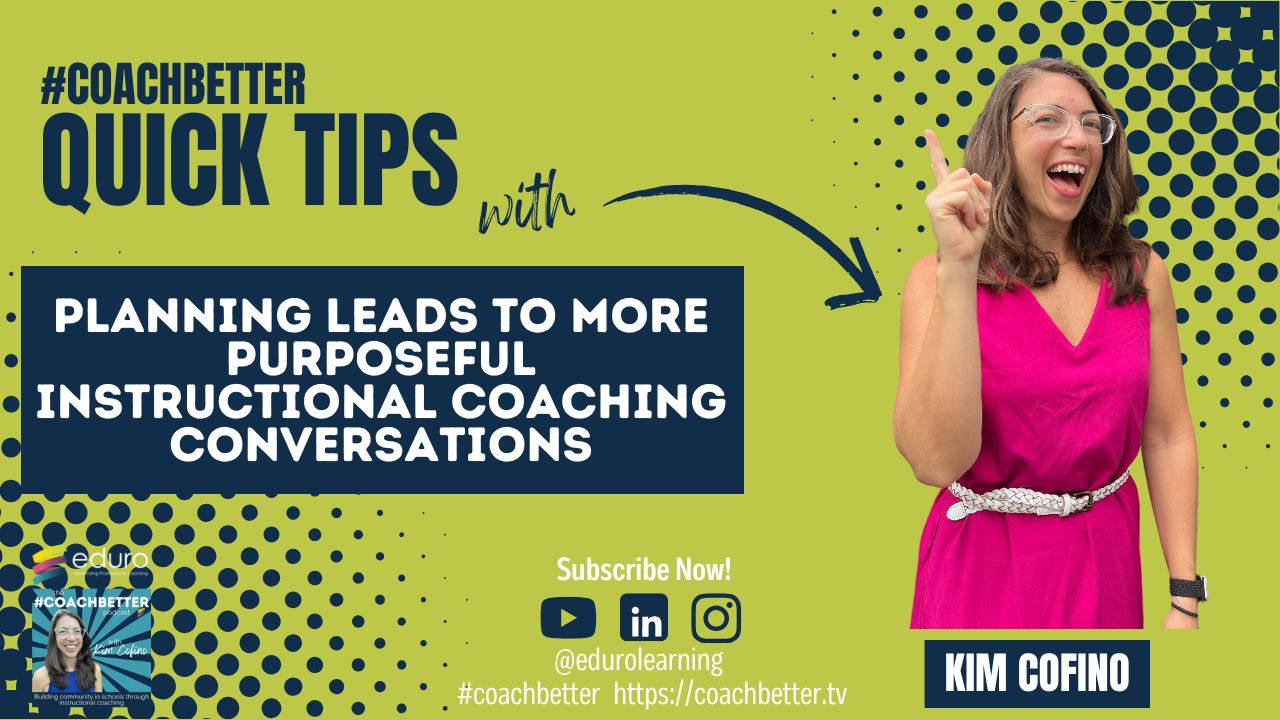
Let’s talk about the power of planning for coaching conversations.
I know you know how to have a conversation. We all know how to have conversations. We’re having them all the time, right? So when we start to do coaching work, we often think we can step into coaching conversations similar to the way we might approach any other work-related conversation. We might think we know where it might go or what we’ll talk about. We might even think not planning is a good way to let our coaching partner guide the conversation. Coaching is all about ensuring our coaching partner has agency, right?
But there’s a difference between having agency and having structure.
And that’s the key.
That’s the mindset shift that my graduate, who we’re calling Mark for this episode, made while he was in the Thrive Coaching Certificate. You already know Mark is an experienced coach, he had lots of training, and he’d been coaching for several years. So, naturally, he felt confident in his coaching conversations (rightly so). But, even with all this experience (and confidence) he made a big realization during his time in the Thrive Coaching Certificate. Practice and experience can make the coaching conversation flow.
But what makes a coaching conversation feel purposeful and intentional is planning.
When we started talking about why it’s so valuable to plan coaching conversations, Mark started to be more intentional about his pre-planning work. And that’s when he realized that planning made each conversation much more purposeful. Even though he could walk into a coaching conversation and let them take a natural path, and they would go well, he realized they could be even better (and he made it happen).
During the Consistency phase of the Thrive Coaching Certificate (Phase 2) we go deep into the micro view of your coaching practice, and in one of our units we focus on the structure of a coaching conversation.
Here’s when Mark had a big realization: It’s not about planning WHAT you or your coaching partner will talk about (although you do want to stay focused on your coaching partner’s goals). It’s about HOW you structure the conversation.
Coaching conversations are conversations with purpose.
Yes, we’re:
- reflecting.
- ensuring our coaching partner has agency.
- making sure to be invitational in the direction we go.
But that doesn’t mean there’s no structure or no purpose. And having structure and purpose means that we need to do some planning before the meeting, some reflecting afterward, and some intentional structure during the conversation. This is what separates a meandering, unfocused conversation, from one that has a purpose. And our coaching partners need to feel that purpose in the moment, during the conversation. Because no one likes a meandering conversation that feels like it has no goal.
For teachers to opt-in to coaching conversations, they need to feel like it was worth their time. And we do that by ensuring each conversation has a purpose, a structure, and an opportunity for our coaching partners to recognize the value of their time spent. This is not easy. It’s part of why we want to focus on the micro view of our coaching practice – and why this element is included (at different levels) in both Getting Started as an Instructional Coach and the Thrive Coaching Certificate.
Reflecting on the growth in his practice at the end of Phase 2: Consistency, Mark said:
I’ve realized that I need to be more intentional about how I plan for each session. I’ve begun blocking out more dedicated time before each meeting to reflect on previous notes and consider the best path forward. While I always start by asking the teacher, “What’s the most important thing for us to talk about today?” I go into those meetings better prepared with a “toolbox” of potential questions. I don’t follow them like a rigid checklist, but having them ready allows me to pull out the right tool exactly when the coaching partner needs it.
Let me share another great example – this time from a brand new coach – so you can see how this challenge can happen to both experienced and new coaches alike!
Last year on the podcast, I shared a case study episode with one of my amazing graduates, Angela Mee Lee, who was brand new to coaching (in contrast to Mark). She had recently graduated from the Thrive Coaching Certificate (then called The Coach) immediately after finishing Getting Started as an Instructional Coach, and she shared her own story of feeling the tension between providing teacher agency and ensuring a purposeful, meaningful discussion.
As she said on our call
“When I started out on my coaching journey, I was probably having a nice conversation without a direction. Now I have a framework and a purpose for those conversations.”
And even though they might have been very nice conversations (as Angela points out), she realized that they needed to have a clear purpose so teachers would see the value in spending their time with her. So here’s what shifted for both Mark and Angela (in two separate cohorts, at two very different phases in their coaching careers):
Once both Angela and Mark started planning coaching conversions intentionally, teachers were able to immediately see the impact. These conversations became about more than just being listened to, they became about meeting the teachers goals, about ensuring there was an outcome from every session. Each time teachers work with a coach who plans with intentionality, so each conversation has a purpose, they are moving closer to their goals.
Even though the prep for each conversation might look different – and the level of depth that you’re able to plan might be different – it’s about developing the skills that enable you to plan with intentionality, so teachers can feel the impact immediately. Which is exactly what will encourage them to spend more time coaching with YOU too.
When you move from classroom to coach, there are a lot of big shifts you need to make – one of them is how to structure, plan and facilitate a coaching conversation. It’s part of the difference between working with children and working with adults. And that’s one of the big shifts you need to make when you first move into a coaching role.
Want to see what it might be like to move into an instructional coaching role in reality?
I’m offering a free LIVE workshop on exactly that topic to help you work through some of the surprises you might face in stepping into a new role. You’ll learn all about the ways that you might be expected to:
- lead without being a formal leader;
- see the big picture, often without having all the puzzle pieces;
- inspire your colleagues without having a class of your own; and
- be the connection between teachers and leaders, without really being part of either team.
It’s not always easy to make this transition, and there are some key strategies you can apply to feel confident, calm and capable – even in your first year as an instructional coach! We’ll talk them through together on this LIVE workshop. Get all the details and register at edurolearning.com/live
I shared stories from two coaches – one experienced and one new to coaching – with you today because making coaching conversations feel purposeful in the moment and have a tangible outcome for our coaching partners is a challenge that presents itself again and again. Angela was brand new to coaching, and she learned how important it is to prepare for coaching conversations, in our course Getting Started as an Instructional Coach. And Mark, who is a very experienced coach, had the same problem. But it happened for a very different reason – and if you’ve been coaching for some time, you might already be recognizing what happened here.
The first time you experience this (like in Angela’s story), it’s usually because you feel you don’t know what to do, and you’re just trying to figure it out. You might start having coaching conversations without training or without following a framework, and those conversations can meander. Then (again, like Angela), you might take a course, like Getting Started as an Instructional Coach and then the Thrive Coaching Certificate, and learn that there is a framework you can follow – and you can intentionally practice, get feedback, and improve both your planning and your actual conversation skills (which we do inside both of those courses – based on your experience level).
And then, over time, as you have more and more coaching conversations, you start to internalize the framework and feel like you can start having those conversions without as much prep. Because you have enough experience to do them without all the prep you used to need.
But that’s the thing. Now the prep is different.
What’s YOUR level of coaching mastery?
All coaches go through various stages of coaching mastery. Once you identify where you’re at, you can begin to build the skills needed to move to the next stage.
This quiz is based on real-life case studies compiled from years of working with coaches inside The Coach Certificate & Mentorship Program!
When you receive your results, you’ll also get your matching case study from the STRIVE Case Studies to see where you fit in the stages of coaching mastery.
Ready to tackle your challenges and move on to the next level in YOUR coaching practice?
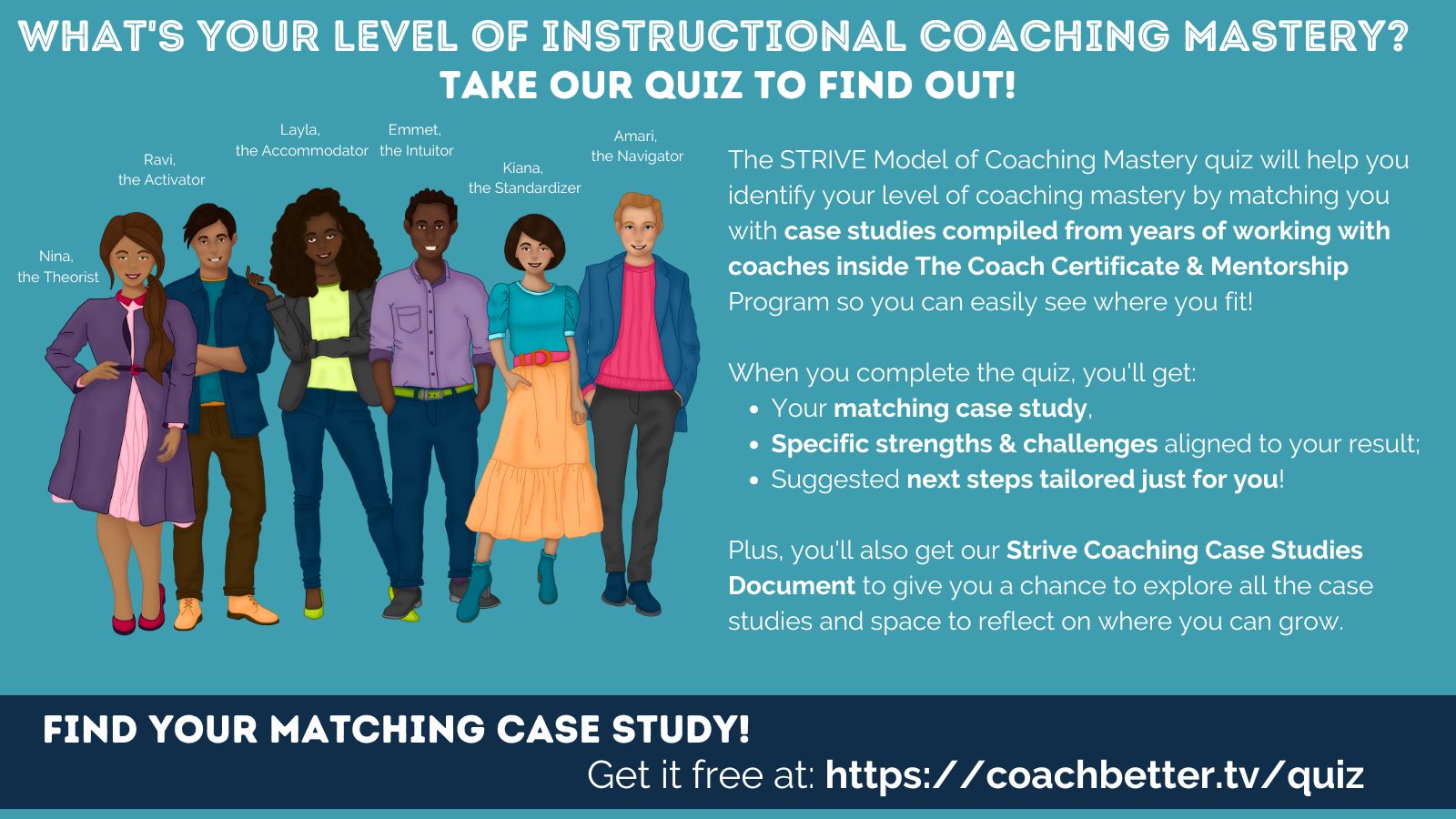
The STRIVE Model of Coaching Mastery quiz will help you identify your level of coaching mastery by matching you with case studies compiled from years of working with coaches inside The Coach Certificate & Mentorship Program so you can easily see where you fit!
When you complete the quiz, you’ll get:
- Your matching case study,
- Specific strengths & challenges aligned to your result;
- Suggested next steps for each stage;
Plus the Case Study Document includes:
- Case studies leveled by coaching mastery;
- A framework to identify essential stages of professional growth & key areas to focus on in your professional learning;
- Alignment with the THRIVE Model for a Successful Coaching Culture;
- Space for you to reflect & prioritize so you can take action immediately!
You’ll go straight to the Quiz, and get the Case Study Document via email.
You’re not planning the actual structure of the coaching conversation (which might be pretty consistent for most people). You’re planning for what your coaching partner needs right now, on a very individual level – based on previous conversations and what you know about them and their goals. That’s exactly the realization Mark made in the Thrive Coaching Certificate. When we did our deep dive into the structure of coaching conversations and he started to shift his practice to take more time for prep, and add more structure into his coaching, he made an important mindset shift for experienced coaches. The prep doesn’t have to take very long, but it can have a huge impact in terms of the intentionality of the conversation and the visible outcome of the time spent for teachers.
For experienced coaches it’s not about the what, as in “what is a coaching conversation?” or “what is the structure of a coaching conversation?”. It’s about “how can I ensure the structure of today’s conversation provides value and purpose for my coaching partners goals right now – based on everything we’ve done together?” It’s a subtle shift, but one that all coaches make over time – and usually with new learning and feedback. No matter how long you’ve been coaching, there are always opportunities to deepen your practice and tweak your skills – to make every conversation more purposeful and meaningful for your coaching partners.
Both Mark and Angela’s stories show how your coaching skills spiral up with you as you grow, and as you learn more in your practice – particularly when you take the opportunity to focus on your own learning and seek feedback on your practice. Mark already knew how to have a coaching conversation with a structure, but he was able to refine his practice within the Thrive Coaching Certification to identify a consistent starting (and ending) point to his conversations, so that the additional prep he added in helped those conversations feel more valuable and purposeful for his coaching partners. Angela was just learning how to have a coaching conversation, and she was able to shift from having “a nice conversation where someone was genuinely listening and asking great questions” to a conversation with purpose, so that teachers felt like their time spent being coached was intentionally moving them closer to their goals.
Coaching is complex, and whether you’re brand new to the concept, or you’ve been doing it for a while, taking the time to reflect and refine your practice is essential.
Today we really focused on the micro view of your coaching practice, thinking about the importance of:
- Planning for a coaching conversation
- Following a framework (like the one we use in Getting Started as an Instructional Coach and the Thrive Coaching Certificate)
- Ensuring that within that process we are providing agency and authenticity for our coaching partner, and
- Continually refining your practice over time
All of those things are important no matter how much coaching experience you have! (And as we often talk about, you really only get the opportunity to develop those skills at the micro level when you’re actually able to have coaching conversations – and that only happens when you are intentional about understanding the macro view so you can leverage your informal leadership to advocate for the conditions needed for coaching to actually happen in your school setting!).
So, wherever you are in your coaching practice, I invite you to take a moment to reflect:
- Are you taking the time you need to prep for your coaching conversations? If not, how might you create space and time to do that within your day?
- Do your coaching conversations feel like conversations with purpose? How are you getting feedback from your coaching partners that helps you recognize that?
- Where might you have opportunities to grow at this micro level in your coaching practice?
Because no matter where you are in your coaching experience, I promise, every single person you coach wants to feel like the conversation has a purpose, and that they are getting lots of value out of the very limited time they have to spend with you. It’s not enough to just feel listened to, or process thinking, we want our coaching partners to leave each conversion feeling like they are moving closer to their goals, with a clear path forward, so they can see a tangible outcome for the time they spent coaching with you.
You might have heard me say on another episode or in a workshop, that coaching conversations should be like Starbucks. You have your own custom order (mine is a brewed chai tea latte with oat milk and no sugar), and you can get your custom order wherever you go, and you know you’re going to get exactly what you ordered. And even though every other person in line probably has a different order, they’re still having the same experience.
In a coaching sense: the coaching outcomes and goals are unique for every person you work with. But they know when they sit down to a conversation with you they’re going to get closer to their goals, in a predictable way, without wasting their valuable time. That’s how you build trust and belief in the coaching process – and how you can start to build momentum around the concept of coaching at the macro level too!
WATCH THE VIDEO OR LISTEN TO THE PODCAST
🔗 KEY LINKS FOR THIS EPISODE
- Getting Started as an Instructional Coach
- Register for the LIVE Workshop: New to Coaching
- Join the Getting Started Waitlist
Ready to create a coaching culture that improves student learning and builds belonging?
Come learn with me!
I help educators, instructional coaches, informal or positional leaders work together to create thriving coaching cultures that improve student learning and build belonging.
Coaching programs based on the Thrive Model, with clarity, consistency and community, can create time and space for educators to feel seen, heard, respected and valued for the experts that they are – creating a sustainable system of educator professional growth that ultimately improves student learning.
For this kind of coaching to thrive we need to focus on both the micro view of your coaching practice and the macro view of your coaching program, so while you’re developing your individual coaching practice you’re also intentionally developing a sustainable coaching culture.
If you’re ready to build this kind of coaching culture in your school community, join us for the Thrive Coaching Certificate program!

Wherever you are in your coaching journey, we can support you!
When you’re ready, there are three key ways we can work together:
- in the Thrive Coaching Certificate,
- in a private mentoring package, or
- through work directly with your school.
Leave a comment below, or reply to any of my emails and let’s start a conversation to see how we can work together to create a thriving coaching culture in your school setting!
Connect with us!
- Subscribe to the podcast iTunes | Spotify | Stitcher
- Follow us on social media: Instagram | LinkedIn | YouTube
- Join our #coachbetter Facebook group
- Read more from Kim: all books & articles
- Explore our courses for coaches
Recent Comments