

In #coachbetter episode, Kim chats with Dr. Lindsay Prendergast, who’s currently Assistant Director of the Danielson Group, and a best selling author. Lindsay was a teacher, administrator and a coach for many years before shifting to work with the Danielson Group.
In this conversation, they talk about:
- Why appraisal and supervision is so important – and should be seen as a gift
- How appraisal has gotten twisted, and become so punitive
- Where coaching fits into this process
- Where the lines get blurry when administrators seek to bring coaching into appraisal
- How we can help draw a clearer distinction between supervision, appraisal, evaluation and coaching and growth
- Why the language and the naming of processes (like appraisal, feedback, and coaching) so important
- What schools (coaches & leaders) need to consider as they are working towards building plans for both appraisal and growth
This conversation might be controversial because it unpacks so many challenging concepts that are a key focus in many senior leader conversations. It is absolutely essential that we have clarity on the difference between appraisal and growth.
Connect with our Featured Guest

Subscribe to #coachbetter via your favorite Podcast Player!




Bonus! Watch the Spotlight Version on YouTube!
Show Notes
Please share a little bit about your journey as an educator, and the work you’re doing now
First half of career in Colorado, Special Education, worked in a district where people wore a lot of hats, got to be involved in a lot of district leadership. Started to get a Masters in Counseling, and in doing so, I got tapped to apply for an admin. AP & Guidance Counselor, Masters in both. Was one of the best things that ever happened to me. Training from counseling massively informed my work as an admin.
Moved international, landed in the Dominican Republic as Principal. That’s where I first gained experience with the Danielson framework, and started using frameworks to support teachers. While I was there, I was accepted to become a framework specialist for Danielson. Became a coach for NWEA on a project in Las Vegas, coaching about 20 principals leading “failing schools”. Former admin, now a coach. Danielson work was on the side. About a year and a half ago became a full time member of the team. Now I oversee strategy. Oversee all international work.
Please tell us a little bit about the importance of appraisal and supervision – and how this is distinct from a more general concept of “feedback”.
Appraisal and supervision is essential to exist in a school, for no other reason that it would exist in any other industry, not for what people might construe it as punitive, or critical to the point where people feel as if they’re not valued. Appraisal speaks to our professionalism. The expectation that we’re professional seems to have been watered down over time. Appraisal is the formal process that can attend to that professionalism. Appraisal upholds that expertise.
Feedback can play a role in appraisal, but it’s a process by which educators might communicate with each other in an informal matter to discuss their practice. The distinction there is around the feedback and the appraisal piece is more directive (in a dynamic of employer and employee) and a feedback in a different environment doesn’t have that.
How has appraisal gotten so twisted?
People interpret appraisal differently, there’s a softening of the expectation that people can handle it. Clear is kind, but the skill of being able to deliver it is not as strong as it once was.
If practitioners don’t leave stronger when they leave your school, you’ve wasted that time. When you are held to high expectations, that is a form of love. A trend I’ve observed is coming out of the pandemic, administrators were so hands off because they wanted to ensure retention, and that model retained. Lots of leaders started “befriending” teachers, the way teachers do when they want to be liked by kids. Reticent to hold up expectations in fear of people quitting. And now student learning is suffering. Now it’s scramble to adapt.
Where do you see coaching fitting into this process?
Coaching is what fuels growth. Appraisal without it is the hammer, but nothing more. Coaching should be the dominant element of a professional learning system because it is what fuels the growth. Evidence collected in appraisal can set the stage for the learning, but coaching is so much more likely to cause growth because the nature of it is non-evaluative. Being able to be vulnerable is the fundamental necessity for coaching to cause growth is not able to exist in evaluation / appraisal. That can only be done by coaching. If only coaching were the vast majority of the interactions.
What’s YOUR level of coaching mastery?
All coaches go through various stages of coaching mastery. Once you identify where you’re at, you can begin to build the skills needed to move to the next stage.
This quiz is based on real-life case studies compiled from years of working with coaches inside The Coach Certificate & Mentorship Program!
When you receive your results, you’ll also get your matching case study from the STRIVE Case Studies to see where you fit in the stages of coaching mastery.
Ready to tackle your challenges and move on to the next level in YOUR coaching practice?
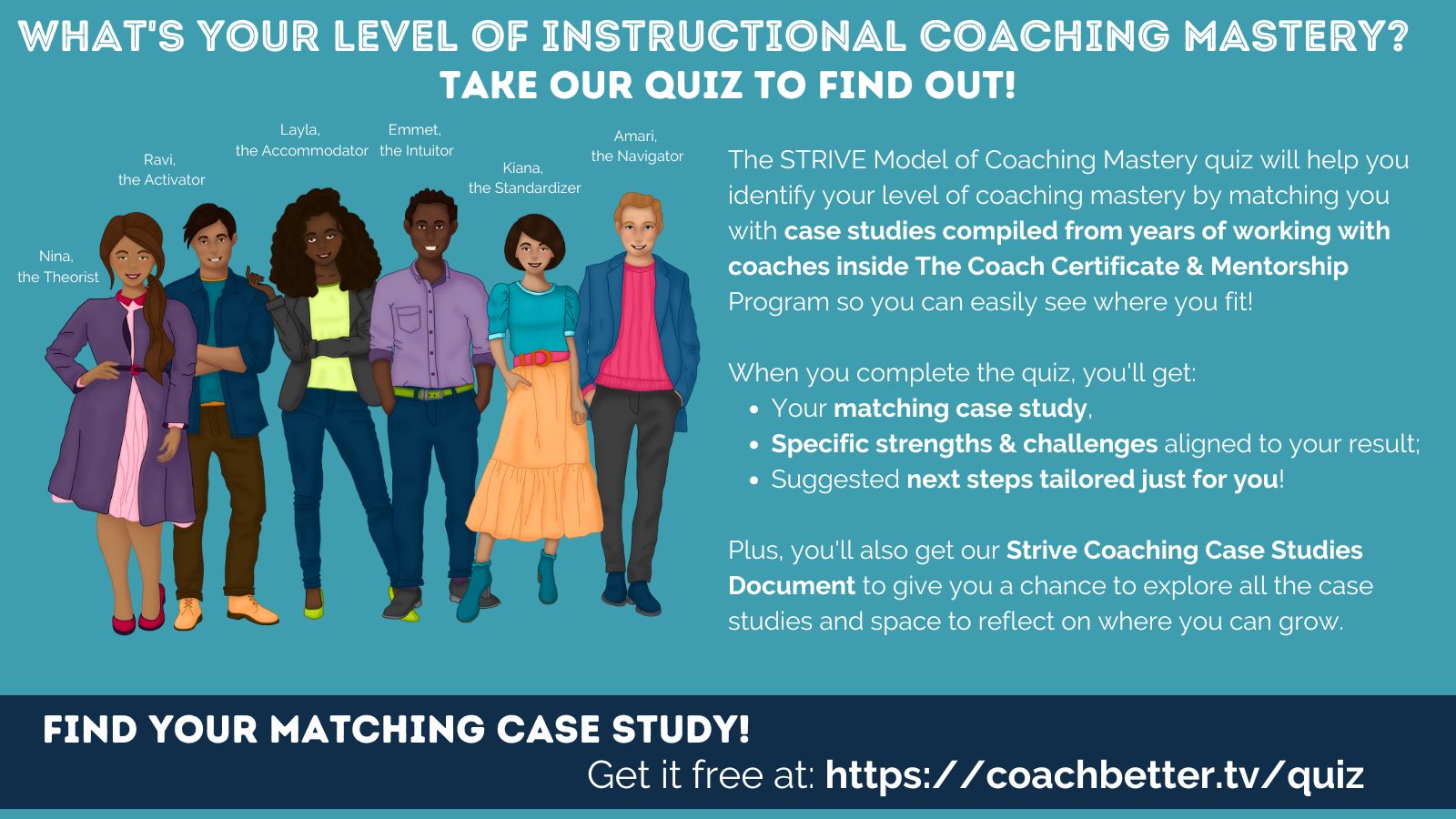
The STRIVE Model of Coaching Mastery quiz will help you identify your level of coaching mastery by matching you with case studies compiled from years of working with coaches inside The Coach Certificate & Mentorship Program so you can easily see where you fit!
You’ll go straight to the Quiz, and get the Case Study Document via email.
Show Notes continued…
When administrators are working to bring a coaching mindset into their practice, where do the lines get blurry?
Understanding why it’s important that they be distinct is to recognize the power dynamic / power differential. Try to understand it from the perspective of the person across from you.
The implications of unconscious bias. You have to put up a mental block from infusing a coaching conversations with your expertise. You need to start from understanding that we are at a place in the school that we understand at a minimum that teachers understand the language being used for the conversation we’re having when we’re evaluating. They understand it equally as the evaluator. When leaders want to shift into a coaching mindset there needs to be clarity between them and the person they’re sitting across from, ideally with permission. Are we in a space where I can shift into a coaching conversation now? And it’s ok to say no. If you are shifting into a coaching stance, there’s the risk for it feeling prescriptive. They need to learn the skills of coaching – administrators assume they have coaching level skillsets.
How can we help draw a clearer distinction between supervision, appraisal, evaluation and coaching and growth?
In an individual system like an international school or district of schools, it starts at the top. A clear distinction of those protocols & processes that are designed and understood by the audience. Definition should involve participants from all sides. In most systems it’s designed around a table at a leadership meeting. If coaches are not at the table it creates a gap, because they are such critical players in this overall system, because they understand the experience of the teachers so well. If it’s all designed by those who are evaluators, it’s going to biased towards them.
Clear definitions that are agreed upon and understood by all stakeholders. Which requires bringing all voices to the table. Leaders might be at risk for a misstep because of thinking that the system should be defined by them because
If you as a leadership team are saying that instruction is paramount, why wouldn’t you bring the people doing the instruction to the conversation. Time is a limitation except that it shouldn’t be a constant ongoing conversation to define roles. Nothing about us, without us, is for us.
Why is language and the naming of processes (like appraisal, feedback, and coaching) so important?
The teacher is the one who’s left in the dark if it’s not clear. The teacher is spending half of their bandwidth trying to guess what is the role and what are the implications for me. It puts the teacher in a vulnerable spot where they might not otherwise be. We owe it to everyone we supervise. It is almost unkind to not name and even worse to name it something else than what it is, people are smart enough to figure out if it’s a bait and switch. It’s a trust breach. It’s a dimisher of professionalism in the system. Teachers lose confidence in their leaders, when people don’t have confidence in their leaders, things diminish overall. The collective efforts of the system to get better suffer. It’s a significant and straightforward step to take to clarify roles that isn’t as clear as they could be.
What might schools (coaches & leaders) need to consider as they are working towards building plans for both appraisal and growth?
Before any of this begins, there should be common agreement on the purpose – what is our intent and how does it fit within the goals of the school. Focus on the skills and competencies within a framework that are aligned to your current goals / needs of the school. Align them to your purpose. Bring all your stakeholders to the table early and then often. Do not exclude the coaches from the conversation. Make it a priority to accept or identify / recognize their role in this dynamic. Own it, name it, find out what others think of you first, if needed. Remove that cloak of “of course everyone thinks I’m great” to understand really the position you sit in. Power dynamics are rarely talked about but always present. As the person with the power in that, it’s on YOU to drive how that plays out.
Ready to Learn More about Instructional Coaching?
If you’re ready to take the next step in your coaching journey, let’s work together to make it happen!
Get Started With a Free Workshop!
To continue your learning, watch one (or more!) of our free workshops for instructional coaches – available right now!
Each workshop is designed for your experience level so you can take the next step in your learning right now.
Start with a FREE workshop here:

Find them at: coachbetter.tv/learn
Wherever you are in your coaching journey we can support you!
When you’re ready, there are three key ways we can work together:
- in a course,
- in a private mentoring package, or
- through work directly with your school.
Leave a comment below, or reply to any of my emails and let’s start a conversation to see how we can work together to create a thriving coaching culture in your school setting!
Connect with us!
Subscribe to the podcast iTunes | Spotify | Stitcher
Follow us on social media: Instagram | LinkedIn | YouTube
Join our #coachbetter Facebook group
Recent Comments