
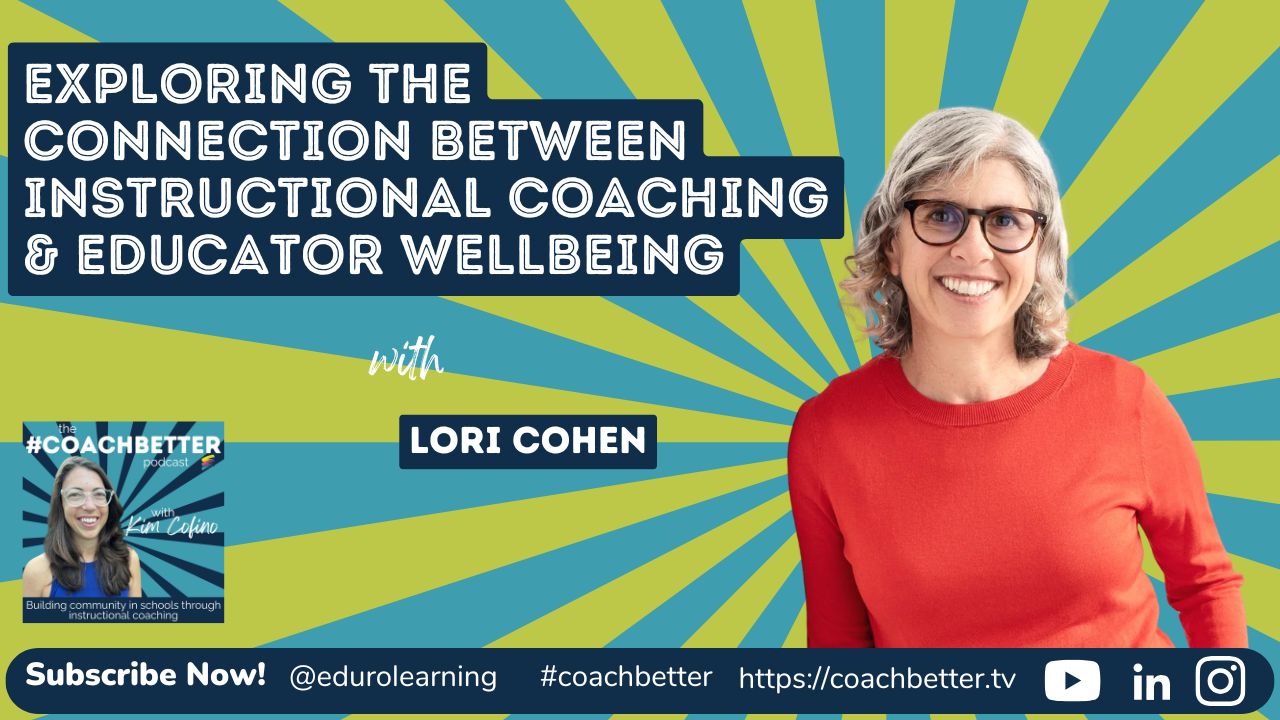
This #coachbetter episode about the connection between instructional coaching and educator wellbeing with a special guest, Lori Cohen. Lori has been a teacher, instructional coach, site leader, professional development facilitator, and published author over her 3 decades in education. Her whole career has been dedicated to professional learning, from designing a Teaching Fellows program for new teachers, creating in-house professional development tailored to the needs of the staff, building instructional coaching programs, and serving as the Dean of Faculty where she oversaw the overhaul of teacher growth and evaluation. Lori is also the co-author of one of Kim’s favorite books on professional learning, The PD Book, among several other fabulous books!
Connect with Lori

Subscribe to #coachbetter via your favorite Podcast Player!



Show Notes
Tell us about your education background.
I knew I wanted to be a teacher by the end of HS. I went straight into teaching right out of college. Been at this since the late 90s. I knew I wanted to teach English/ Humanities. I spent 20 years in the classroom, even when I was a building leader. Taught in public schools, independent schools, while in independent schools, I was made a coach. I was handed a few books and then asked to coach teachers, without knowing anything about coaching. After a few years, and more training, I developed the coaching program, a mentoring program, and eventually became the school’s Dean of Faculty. It was in those final years that I started looking at bigger questions like systems. In 2019 I left the school system and went into consulting. Authored four books.
We both believe that coaching is for everyone, what makes coaching so special?
Coaches get to see the whole system because of the directions in which they work. There’s the direct one-on-one work that coaches get to do and supporting educators, but then there’s also working with building administrators, thinking about the professional learning people need, thinking about the human to human skills of being an effective coach, thinking about curriculum development and pedagogy. The coach needs to be well versed in so many elements of a school system. And there’re also an essential element of teacher self-efficacy, and developing collective efficacy through the questions they ask, and the learning they facilitate that supports teachers having a greater sense of their own agency and autonomy and growth. Coaches get to bear witness to that. They get to nudge, they get to support, they get to collaborate. Sot’s a golden job in this field of education.
What are some of the biggest barriers to successful coaching?
One of the biggest barriers is that people who become coaches don’t know what coaching is or what it entails, and they don’t receive the support to do it well. If coaches are not well supported, teachers aren’t going to want to work with them. It creates a crescendo effect of ineffective preparation because if you’re not set up well to be a coach, then it also has multiple impacts on systems. And then leaders then decide not to fund that next year, and then they chase the next shiny object along the way.
Why are those systems so important?
When I was the only instructional coach in the school I remember feeling like I was pedaling a product that nobody wanted to purchase. I felt like I was walking in with my sandwich board of possibilities. And then in the intervening years, even when I built the program, even when people had been coached by me and had we had developed a culture of coaching, there still was this initial beginning of the year slog for our coaches to feel like they could get some footing with people. I felt like we had to do a lot of socializing of the community around coaching first to make sure it was successful.
What did the socializing look like?
Consolidating everything around professional growth into a document in the faculty handbook, systematizing and synthesizing all the growth possibilities and seeing it as a unified ecosystem including: new teacher coach, building instructional coach, mentors, new teacher coach, lunch and learns.
Letting the staff know that we needed to have non-evaluative, non-judgemental moments of witnessing teaching in the school. We created informal opportunities to understand the landscape of teaching here by doing regular classroom walkthroughs. This normalized classroom visitors.
Every new teacher had a coach for an acculturation process. We let people know what coaching is in the hiring process.
You recently wrote a book, Integrating Educator Well-Being, Growth, and Evaluation: Four Foundations for Leaders–and have a new one in September, The Science of Lesson Planning—how does coaching fit in?
Wellbeing is a gap in the school ecosystem. There are layers and dimensions to wellbeing. The one that’s within the coaches’ agency is relationships and emotional intelligence. That a coach is a strong, supportive, trusting relationship is the foundation for supporting educator wellbeing. Coaches and the folks that they work with need to have a trusting relationship. There needs to be psychologically safe enough, uh, conversations and spaces.
The base layer of wellbeing is psychological safety and relationship. Increased trust and increased psychological safety means greater opportunity to learn, take risks, practice mistake making, and for the coach to get and give feedback. It has to be cyclical in some kind of way. That contributes to tie wellbeing to collective efficacy by increasing teacher autonomy.
It increases the teacher’s desire to learn, but coaches need to be modeling that and modeling that mistake making.
Another level of wellbeing is the emotional component to what it means to be an educator. We feel great pride and joy when we are successful. We feel deep anger and frustration when we don’t feel heard or valued. We feel overwhelmed most of the time if we’re in classrooms full-time or even just working in school buildings in the world these days. Coaches need to be attuned to the conditions that support educators to be well in this work, and to be able to assess those conditions and help somebody process their emotions and their thoughts and their beliefs.
Coaches can support educators in how they manage their workload, set boundaries, practice rest, and self-care. The health of the teacher directly correlates to the health of students in classrooms. A coach can, in that trusting, nurturing relationship, create the conditions for that same level of trust and bond that supports learning that we do with kids in classrooms.
What’s YOUR level of coaching mastery?
All coaches go through various stages of coaching mastery. Once you identify where you’re at, you can begin to build the skills needed to move to the next stage.
This quiz is based on real-life case studies compiled from years of working with coaches inside The Coach Certificate & Mentorship Program!
When you receive your results, you’ll also get your matching case study from the STRIVE Case Studies to see where you fit in the stages of coaching mastery.
Ready to tackle your challenges and move on to the next level in YOUR coaching practice?
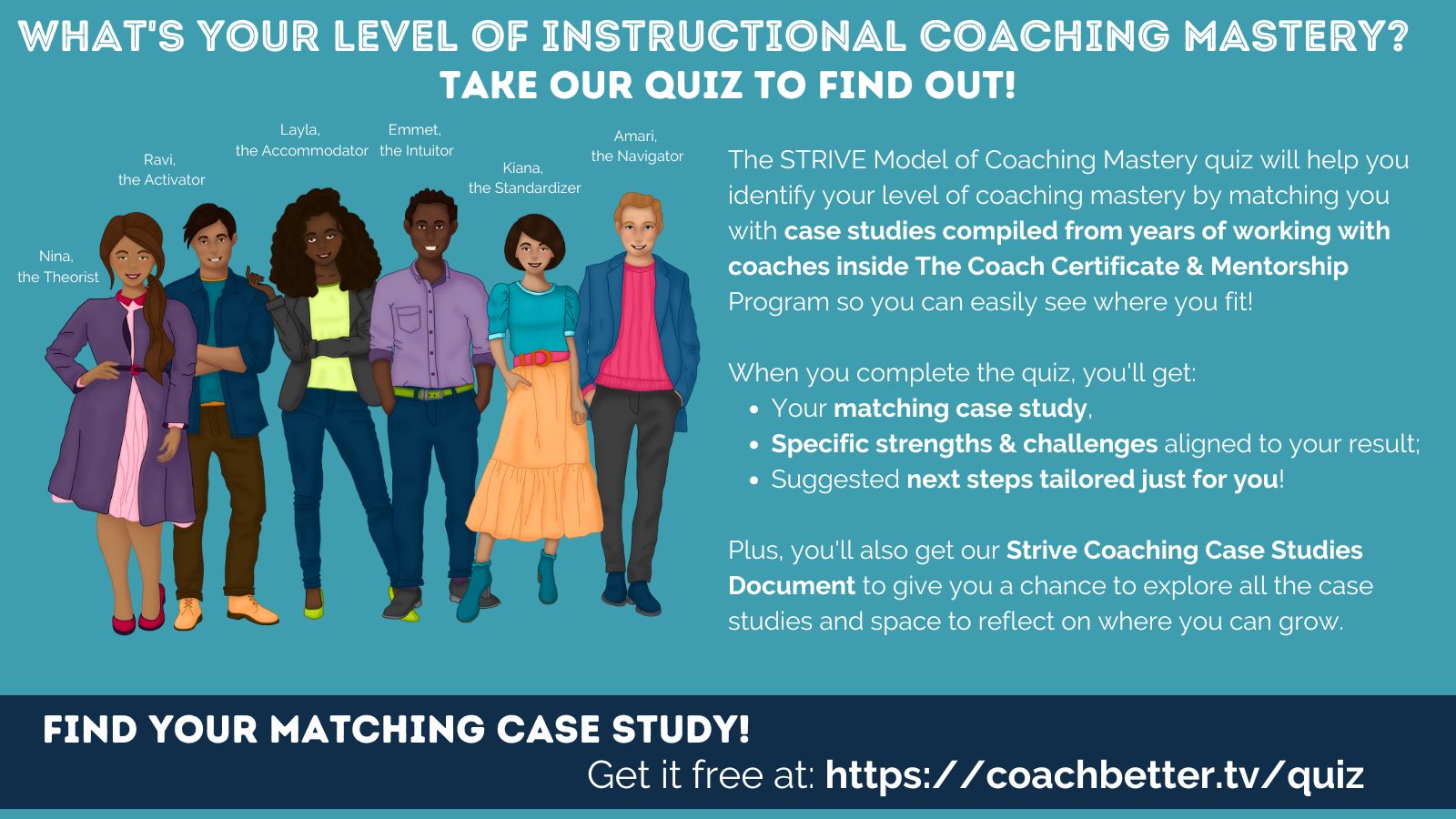
The STRIVE Model of Coaching Mastery quiz will help you identify your level of coaching mastery by matching you with case studies compiled from years of working with coaches inside The Coach Certificate & Mentorship Program so you can easily see where you fit!
When you complete the quiz, you’ll get:
- Your matching case study,
- Specific strengths & challenges aligned to your result;
- Suggested next steps for each stage;
Plus the Case Study Document includes:
- Case studies leveled by coaching mastery;
- A framework to identify essential stages of professional growth & key areas to focus on in your professional learning;
- Alignment with the THRIVE Model for a Successful Coaching Culture;
- Space for you to reflect & prioritize so you can take action immediately!
You’ll go straight to the Quiz, and get the Case Study Document via email.
Show Notes continued…
How do you help school leaders in the work that you’re doing now recognize this connection between educator wellbeing and student learning outcomes and the importance of, you know, caring for the teachers so they can care for the kids?
Start with the global research: Oxford study in 2024
Explode the definition of wellbeing, it’s not just emotions, it’s: compensation, work load management, role clarity, self and collective efficacy, autonomy, agency, inclusion, and policy making, emotionally intelligent leadership, building sustaining and repairing relationships.It’s emotionally intelligent leadership by and large. If those elements aren’t there, we’re missing a lot of the puzzle.
You’ve worked in many different settings – both with and beyond schools – based on all your experience, what makes coaching successful?
Role clarity: get really clear about the purpose of what coaching is, what the coach does or doesn’t do. In order for them to do their job well, they need to know what they’re getting into with their job. Vision and Program need to be well designed
Coach PD: do they have funding for PD, time within the day to coach (not an additional responsibility). Build trust and emotional intelligence.
You recently had a very successful experience with a large school district developing a coaching program, tell us about that and why it worked so well?
Trained up coaches and worked with them for two years in a sustained way. Worked with the Principals next. Layer in all the different people.
Middle and Senior Leaders being part of the training. HoS is in the room. People with the greatest positional power are getting the training. Now coaches don’t feel like they have to coach up. We can collectively talk about confidentiality.
The central office wanted coaching across the district, allocating positions in as many places as we can, in subject-based roles. Wanted to build the culture of coaching.
Led by an initial training, it’s more than just a good conversation.
Designed a district specific coaching cycle, what does it mean to be a coach here, went into the handbook. Met with coaches once a month for a two hour follow up session, went into a skill, practice, give feedback, skill tied to a coaching cycle (testing out each piece: relationship building, goal setting, feedback). By the end of the two years, it was owned by the central office.
Started working with Leaders, how their role is distinct from coaching. Understanding coaching stances and when to use them in their role.
For international schools, where leader and teacher turnover can be especially high, what should school leaders and coaches consider when trying to build sustainability in their coaching program?
Documenting historical memory, systemize things NOT attached to people. As soon as we attach the thing to the person, it’s almost guaranteed to fade away when they leave, unless it is written into the historical memory of the institution: faculty handbook, onboarding, retention and support, hiring. How does it live within the fabric of the institution? The best ideas leave with the people who enacted them & they go on to other places.
Is there anything you wish we had talked about before we wrap up?
Everyone can use coaching skills. It’s not specific to a job. It’s just good practice for how we support people’s growth.
🔗 KEY LINKS FOR THIS EPISODE
- Join the Waitlist for the Thrive Coaching Certificate
- Thrive Coaching Certificate
- Thrive Model
- Episode referenced: Jennifer Abrams
Bonus! Watch the Spotlight Version on YouTube!
Ready to create a coaching culture that improves student learning and builds belonging?
Come learn with me!
I help educators, instructional coaches, informal or positional leaders work together to create thriving coaching cultures that improve student learning and build belonging.
Coaching programs based on the Thrive Model, with clarity, consistency and community, can create time and space for educators to feel seen, heard, respected and valued for the experts that they are – creating a sustainable system of educator professional growth that ultimately improves student learning.
For this kind of coaching to thrive we need to focus on both the micro view of your coaching practice and the macro view of your coaching program, so while you’re developing your individual coaching practice you’re also intentionally developing a sustainable coaching culture.
If you’re ready to build this kind of coaching culture in your school community, join us for the Thrive Coaching Certificate program!

Wherever you are in your coaching journey, we can support you!
When you’re ready, there are three key ways we can work together:
- in the Thrive Coaching Certificate,
- in a private mentoring package, or
- through work directly with your school.
Leave a comment below, or reply to any of my emails and let’s start a conversation to see how we can work together to create a thriving coaching culture in your school setting!
Connect with us!
- Subscribe to the podcast iTunes | Spotify | Stitcher
- Follow us on social media: Instagram | LinkedIn | YouTube
- Join our #coachbetter Facebook group
- Read more from Kim: all books & articles
- Explore our courses for coaches
Recent Comments