
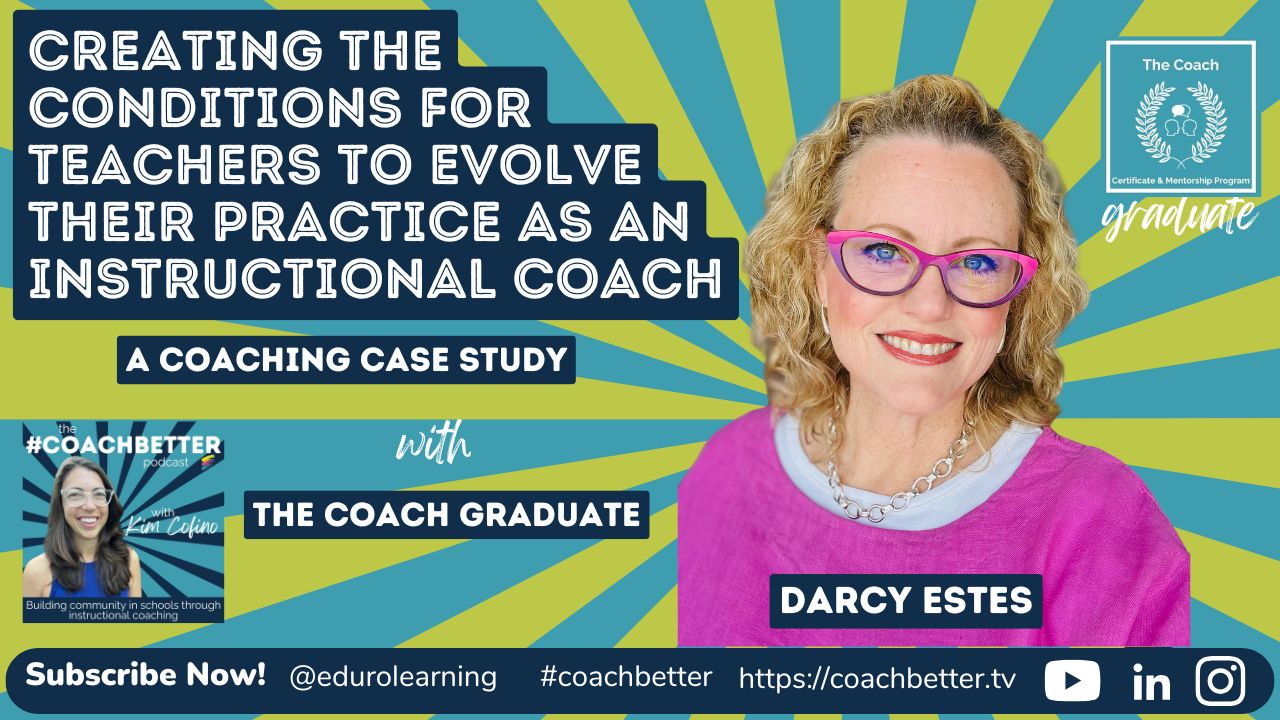
This #coachbetter case study episode is with one of Kim’s Thrive Coaching Certificate graduates, Darcy Estes. They talk about how coaches create the conditions for teachers to evolve their practice including…
- Her experiences in different types of coaching roles
- What she felt she needed to ensure she had a positive experience this time around
- What she learned in the course
- What she’s planning for next academic year, as a result of her time in the course
- Her huge mindset shift about the inventions behind instructional coaching
- The importance of having a strong Coach-Principal partnership
- The foundational element she would have paid more attention to in her first years coaching – if she had realized it’s importance
Subscribe to #coachbetter via your favorite Podcast Player!



Show Notes
Please tell us about your journey as an educator & your current role
It started in 1993, teaching in Arizona. Joined Peace Corp in Belize & did teacher training there. Moved to San Francisco, CA in 2000. Have been doing teaching and coaching in San Francisco since then.
Where did your interest in instructional coaching begin?
Did a combo of special ed & gen ed first grade. A coaching job came up in our district that was intended to fill a gap between beginning teachers & experienced teachers. That job was really fun because I was helping new teachers who were super enthusiastic. Moved over to be a PAR Coach (Peer Assistance & Review) for teachers who have gotten an unsatisfactory review, supporting teachers who were really struggling. Did that for 4 years. At one of the schools I had been PAR coaching, and the principal wanted to make an instructional coaching position. Took that role. Took that role, it was the worst job I ever had. The teachers did not want coaching, they wanted someone to take 1:1 reading instruction, a compromise was reached, where I did half and half. I did try to reach out to individual teachers and had a really negative experience, which has made me gun shy to work with teachers. After several years back in the classroom, I felt like my experience was feeling stale, and wanted to move into coaching.
What was it like making the transition from your previous role into coaching?
When I went to the new school, I remember what it was like in my previous school, and I knew clarity would be very important. Spoke to the principal about defining the role, but I soon realized it wasn’t enough. Just giving the teachers a job description doesn’t really open the doors. So the first year, the role was really wide in terms of responsibilities: 1:1 coaching, coleading instructional leadership team, leading PD. I was overwhelmed by all of the responsibilities the district had bestowed upon me. The first year I went in where I was comfortable, I started with working with new teachers. I was comfortable with that, but then I couldn’t get to grade level meetings, I wasn’t part of the instructional leadership team, so I also focused on leading PD (given by the district).
What’s YOUR level of coaching mastery?
All coaches go through various stages of coaching mastery. Once you identify where you’re at, you can begin to build the skills needed to move to the next stage.
This quiz is based on real-life case studies compiled from years of working with coaches inside The Coach Certificate & Mentorship Program!
When you receive your results, you’ll also get your matching case study from the STRIVE Case Studies to see where you fit in the stages of coaching mastery.
Ready to tackle your challenges and move on to the next level in YOUR coaching practice?
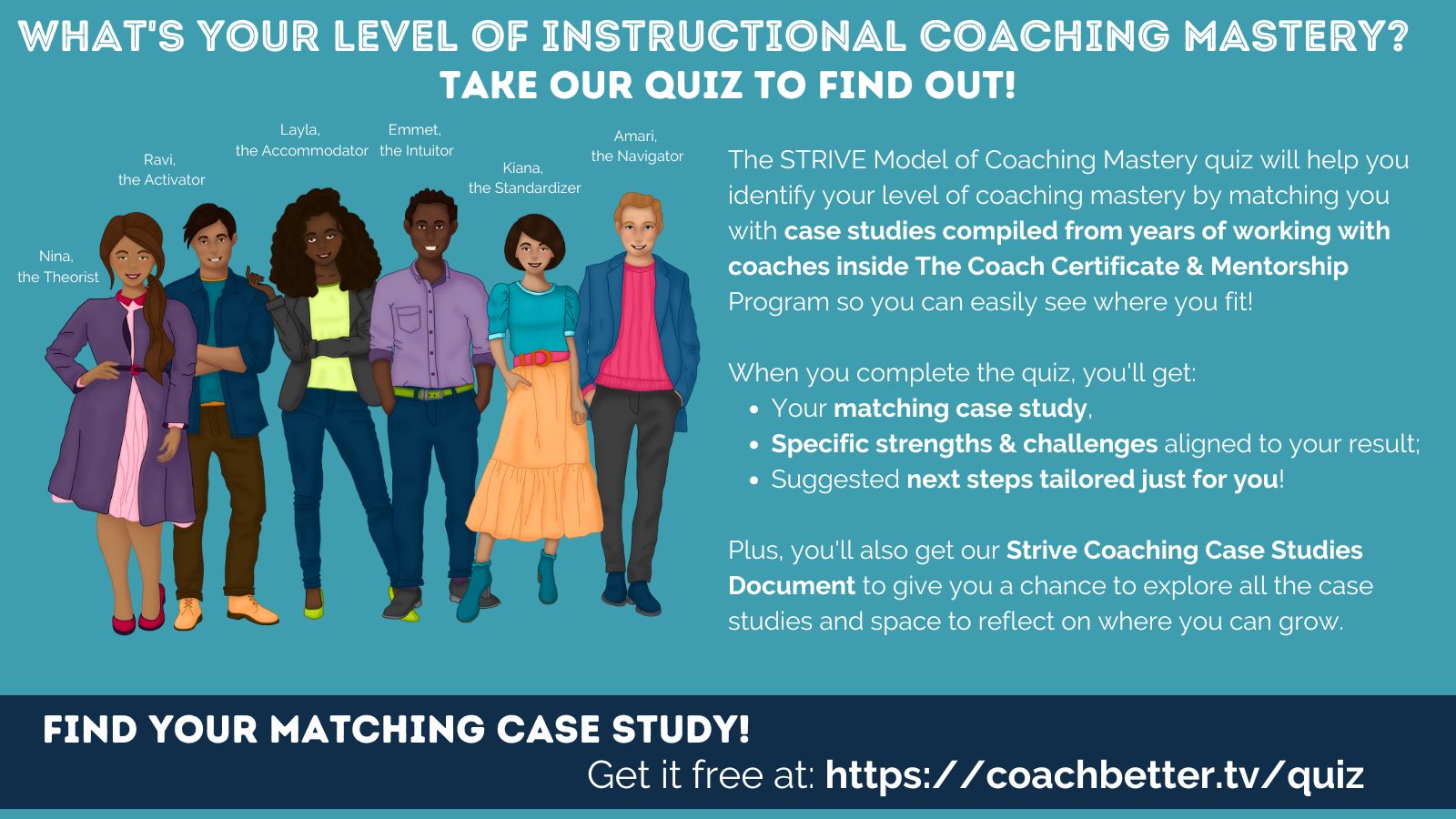
The STRIVE Model of Coaching Mastery quiz will help you identify your level of coaching mastery by matching you with case studies compiled from years of working with coaches inside The Coach Certificate & Mentorship Program so you can easily see where you fit!
When you complete the quiz, you’ll get:
- Your matching case study,
- Specific strengths & challenges aligned to your result;
- Suggested next steps for each stage;
Plus the Case Study Document includes:
- Case studies leveled by coaching mastery;
- A framework to identify essential stages of professional growth & key areas to focus on in your professional learning;
- Alignment with the THRIVE Model for a Successful Coaching Culture;
- Space for you to reflect & prioritize so you can take action immediately!
You’ll go straight to the Quiz, and get the Case Study Document via email.
Show Notes continued…
What eventually brought you to The Coach – what was it about this program that resonated with you?
When I started I brought the program up to the Principal and she said, there was no money. In the second year, I asked again, and I was successful.
The reason I wanted to join the program is when I had been researching your program, you talked about like, are you new to the role? Are you overwhelmed with all the responsibilities? Do you not know where to start? And I was like, yes. My god. That’s it. Yes. So I had looked at the coaching program and really had an interest in doing it. And the reason I was interested in doing it is structure, and there’s sort of two parts to that.
- One is that you have a very clear structure in the program: developing clarity, consistency, community. There was a very clear structure to follow.
- Also structure for myself. Like, sure, I could have gone off and listened to podcasts and read this and read that, but I know I’m not gonna do that because I am too busy and overwhelmed. So I knew being part of a program would give me the structure I needed to hold me accountable. So like, we have things do every week and we have, uh, to, to participate in one-on-one coaching cycles. So there’s this sort of, um, uh, cushioning and, and supporting around learning new things. And I knew I really needed that.
The biggest aspect of having 1:1 coaching was HUGE – having someone who’s skilled and knowledgeable coach me and be able to answer my questions and deepen my understanding, to have my own teacher was amazing. It was as good as I thought it would be. That was the highlight of the program. I got so much from videoing my coaching & getting feedback or sometimes we would watch it together and stop and pause. Having you give me input and facilitate conversations. This is where my big learning arc came out. The learning arc was all about how do you have an effective 1:1 coaching conversation.
I got to experience what a strong 1:1 coaching conversation looks like and sounds like, and very importantly feels like. You are giving that to me, and in those sessions I would sometimes realize, oh, this is a coaching move that she’s doing. Oh, that’s a question that I’ve written down that I should ask.
It gave me the like firsthand experience of the power of that kind of coaching. You would ask me questions and I would really have to think about it, dig into my background into my toolbox and, like what happens in good one-on-one coaching, I was able to come up with the answer. So then I feel good about myself, because I came up with the answer and I really bought into it because it was my idea. So that was one of the big things for me was the one-on-one coaching experience
What’s on your radar for your coaching practice in the upcoming year?
I really want to develop what you talk about as a coaching culture – I’m going to start next year by showing the staff my final project from the course. I want to use that as a segue to establish where I want coaching to go – and that coaching is for you. I see the value of “marketing” like we talk about it in the program – it’s about inviting people to experience this valuable asset that they have access to. I’m hoping to present coaching in a way that opens people up to it, so we can build some word of mouth.
I want to add a “Coaches Corner” into the family communication – because at some point the school is not going to fund this role, and I need to be advocating for this work. The families should know that the teachers are doing all of this work. It’s highlighting their effort and the learning they’re doing.
Another key highlight of my learning was the Instructional Leadership Team (ILT) when I started this year I knew I needed to work on 1:1 coaching cycles. At that time I was digging into Elena Aguilar’s work, I was getting information & practice, and then in our program I had to do a 1:1 coaching cycle. The 1:1 coaching was a natural focus.
The surprise outcome was the ILT. I have been in education since 1993. I have never been part of an effective ILT. I have been through so many frustrating meetings. I could see that team had such potential to become leaders of the school. If we can create a situation where we’re really collaborating around what the school needs. That team was informed that their goal would be small group instruction and they didn’t like that, as that was happening, I understood that that team had to buy in to what they were doing. Otherwise it would be performative. We want this team to have ownership over their work. In this process, we were able to take a step back, and went through an inquiry process to determine our goal: who is responsible for doing the thinking in this classroom. We’ve started to create a team that is becoming more and more committed to the work because they’re the ones driving it, establishing the focus. That is incredible that we went from having a team that wasn’t very collaborative to working together and wasn’t very collaborative to having a team that I think is really evolving into that. And I’m really excited to see where it goes next year.
When you watched the first video of the ILT, a big theme was the equity of voice. You asked me how I could ensure that there was equity of choice, using protocols that we would use with students. So I intentionally started to plan structures and processes that would invite everyone in. Starting to bring in adult learning theory so they would understand the why and have ownership. Offering opportunities where teachers have choice. Being able to ask good questions – so I can work on adding better questions next year
It is mentally exhausting to listen to a 1:1 conversation, and then think about the question that’s going to guide them towards a helpful place. You have to have all those questions ready in your toolbox. When I think of where I want to get to as a 1:1 coach is where I was as a teacher. There’s a complicated choreography there.
When you look back over this year, what are the things that stand out to you (as achievements, as important learning or as “aha moments”)?
Because I was coming from the experience of coaching new teachers, or coaching teachers who were struggling, I thought the coach was supposed to come with the answers. I was supposed to teach them. My understanding after the course is now completely different. I am not coming as the holder of knowledge. It’s tapping into what the teacher needs, being a listener, that’s intuitive, patient and reflective that can create the conditions for deep thinking for teachers to really truly evolve their teaching practice.
There’s so many teachers I’m with, that have years of experience, lots of knowledge, lots of skills. But teaching can still get so overwhelming in the day-to-day. When you’re in the classroom, you’re all alone. You’re the only adult there. And there’s so many things that happen in one teaching day that students and the assessment and all the things and you’re just holding it all.
Coaching is this person who’s there to take care of you and help you take care of yourself by just listening, by reflecting back, and by helping you kind of sort through all of the stuff and pare down and feel like you’re leaving lighter from the coaching session than you did when you came in.
As a teacher you are never done evolving and learning. Teachers don’t often have that opportunity. And to feel inspired by it.
How does your relationship with your principal work?
Build the relationship with the principal so you have the trust. We are in alignment. One of the things that helps is that we have constant communication. We can be very open and honest with each other. The relationship with the admin is key. At the same time though it’s something, I didn’t understand how my relationship with the principal could also be perceived negatively. I share an office with the assistant principal due to lack of space, and the principal also comes in often ’cause we talk about things and we’re collaborating.
And I was telling you one time, that we did some classroom walkthroughs together and I was so excited about that. I thought that was great. And then you pose that question “how do you think it impacts the teachers to see you walking in with the principal on a classroom walkthrough?” And as soon as you asked me that – this is where the questions matter . You could have just told me, but as soon as you asked me, I realized “Oh, that’s not a good thing because coaching is non-evaluative, but here I am standing next to the evaluator and we are coming to observe you.”
The coaching relationship needs to be protected. When you have a coaching conversation with a teacher, this is between us.
Anything else you’d like to share?
If you’re a brand new coach to a school site, the foundational thing to focus on is building trust. Looking back, I would go back and focus on that more. You really have to push yourself out & pop into teachers’ classrooms. You also need someone you can trust to work with and build your coaching skills. Because I trusted her, I was able to take risks and practice coaching. Find people you feel comfortable with. One thing I started doing was planning my coaching conversations more intentionally. Must practice! Be brave and push yourself out of your comfort zone. Be honest!
🔗 KEY LINKS FOR THIS EPISODE
- Join the Waitlist for the Thrive Coaching Certificate
- Thrive Coaching Certificate
- Thrive Model
- Listen to our other conversations with graduates here!
Bonus! Watch the Spotlight Version on YouTube!
Ready to create a coaching culture that improves student learning and builds belonging?
Come learn with me!
I help educators, instructional coaches, informal or positional leaders work together to create thriving coaching cultures that improve student learning and build belonging.
Coaching programs based on the Thrive Model, with clarity, consistency and community, can create time and space for educators to feel seen, heard, respected and valued for the experts that they are – creating a sustainable system of educator professional growth that ultimately improves student learning.
For this kind of coaching to thrive we need to focus on both the micro view of your coaching practice and the macro view of your coaching program, so while you’re developing your individual coaching practice you’re also intentionally developing a sustainable coaching culture.
If you’re ready to build this kind of coaching culture in your school community, join us for the Thrive Coaching Certificate program!

Wherever you are in your coaching journey, we can support you!
When you’re ready, there are three key ways we can work together:
- in the Thrive Coaching Certificate,
- in a private mentoring package, or
- through work directly with your school.
Leave a comment below, or reply to any of my emails and let’s start a conversation to see how we can work together to create a thriving coaching culture in your school setting!
Connect with us!
- Subscribe to the podcast iTunes | Spotify | Stitcher
- Follow us on social media: Instagram | LinkedIn | YouTube
- Join our #coachbetter Facebook group
- Read more from Kim: all books & articles
- Explore our courses for coaches
Recent Comments