
Last year, one of our global cohort members in the Thrive Coaching Certificate got a bit frustrated with me. For the purposes of today’s episode we’re calling them Janelle. That’s not their name, but it’ll make it much easier for me to tell this story. We were at the point in the program where we were just about to wrap up Phase 1: Finding Clarity.
In this phase, we talk all about
- what coaching is (and what it’s not),
- what the research says about coaching, and
- how to make coaching work
It’s all set up to ensure that you really understand why coaching is so valuable and what you need to know to make it not just sustainable, but thrive in your school setting. We were almost at the end of the phase, just about to move on to Phase 2: Implement Consistently where we talk about the process of coaching conversations and cycles, and that’s when Janelle got frustrated. She said: “I already know all this. My job description is clearly outlined. I have support from my district and I feel really comfortable working with my principal. Can I just skip ahead to Phase 2 where I can learn how to have a coaching conversation?”
Before I continue with the story, I want to acknowledge two big components of what Janelle shared here, because you might just skip on by when you’re listening or watching. In just that short sentence, we can see that Janelle has several essential elements to engage more coaching partners in 1:1 conversations taken care of.
These are all from the macro view (I just recently shared an episode about why the macro view is so essential to coaching success)
In this case, Janelle has several items already checked off the list:
- a clearly defined job description,
- support from the school district to focus on coaching,
- a principal who understands the role, and
- is in support of coaching.
Those are all super important in terms of building a culture of coaching (and they’re all part of the Thrive Model that we were going through together in the course, so Janelle knew she was in a good place. But she was still frustrated by the lack of 1:1 coaching she was able to do.
OK, let’s jump back into the story.
At the time, I told Janelle that she absolutely could skip ahead to Phase 2 (we don’t gatekeep the learning in our programs). But when she had filled out her intake form and had her first mentor meeting with me in the course, she had told me that she was struggling to engage teachers in 1:1 coaching conversations and cycles. So I knew at least one of the reasons she came to the program was because she felt really competent in some aspects of her job, like leading PD, and facilitating HODs meetings, but she just never seemed to be able to work with teachers 1:1 and she really didn’t know why. All the way back in that first meeting I asked the crucial question: “do your teachers know what coaching is?” And at the time, her impression was, yes, they do. Because the role of the coach was clear to her, and she had access to a clear job description she assumed that teachers knew what coaches do too.
But that’s actually the challenge.
Just because, as coaches, we know what our job is (or is supposed to be), definitely does not mean that our potential coaching partners know. Teachers (and leaders) have so many things on their plate, they are so busy trying to plan, teach, grade, work with students and their families, attend all of their various meetings, etc etc, they don’t have time to think about what coaches do. And of course, that’s frustrating because we know we can help them. But we can’t if they don’t make the time to work with us.So, here’s where we get back to Janelle.
I mentioned that, of course, she could skip ahead. But I strongly strongly recommended that she finish out Phase 1 first, just to make sure that she really had clarity around all the facets of coaching that are essential for it to thrive.
And this is when the magic happened.
At the end of each Phase, our students create a milestone artifact. One thing that sums up their learning that they can use in their day-to-day work at school. When they share their artifact they also have to write a short reflection about why they chose to create that thing and why it was valuable to them. You’ll never guess what Janelle shared. She made a simple visual infographic about what coaching is, designed for teachers.
And in her reflection she said (and this is as close to the actual quote as I can get):
“I didn’t realize that to get teachers to work with me, it’s not enough for me to understand what coaching is. It’s not enough for my principal or even my district to understand what coaching is. The teachers I want to work with also have to understand what coaching is.”
She nailed it.
Even though she had been in the course for a few months before creating this artifact, she really still thought the problem was that she didn’t feel confident having coaching conversations (yet). But the problem actually was that her teachers didn’t really know why they should work with her. The reason people weren’t reaching out for coaching was because they didn’t know what kind of support they would get – not because they didn’t have confidence in Janelle. They just didn’t know what the coach did or how it could support or benefit them.
This is an important part of building a coaching culture that we talked about in a previous episode (I’ll link it up here and in the show notes for you). If we’re only focused on coaching conversations, we will miss the macro view of a coaching culture – and it’s the coaching culture that we build that allows us to have those coaching conversations – that’s what I want you to take away from this conversation today. Sometimes we can get so wrapped up in our own perceived solution (in this case needing to develop coaching conversation skills) but miss the real problem that’s staring us in the face. That’s why it’s so valuable to have not only a framework to work through – we use the Thrive Model inside the Thrive Coaching Certificate – so you don’t miss any parts that are crucial, but also to have a mentor to keep you accountable and focused on what really matters.
And that’s why I believe in this program so much.
What’s YOUR level of coaching mastery?
All coaches go through various stages of coaching mastery. Once you identify where you’re at, you can begin to build the skills needed to move to the next stage.
This quiz is based on real-life case studies compiled from years of working with coaches inside The Coach Certificate & Mentorship Program!
When you receive your results, you’ll also get your matching case study from the STRIVE Case Studies to see where you fit in the stages of coaching mastery.
Ready to tackle your challenges and move on to the next level in YOUR coaching practice?
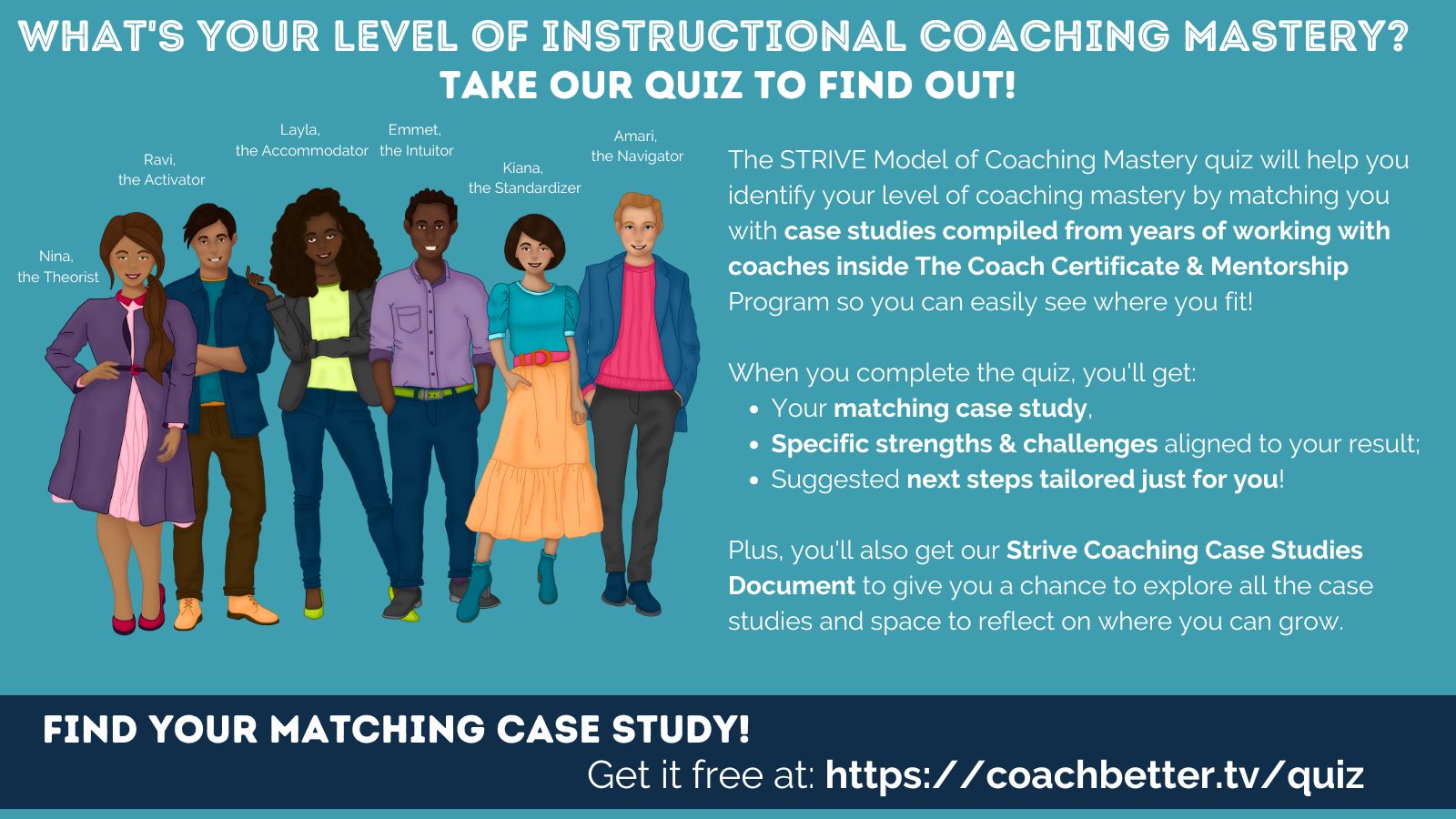
The STRIVE Model of Coaching Mastery quiz will help you identify your level of coaching mastery by matching you with case studies compiled from years of working with coaches inside The Coach Certificate & Mentorship Program so you can easily see where you fit!
When you complete the quiz, you’ll get:
- Your matching case study,
- Specific strengths & challenges aligned to your result;
- Suggested next steps for each stage;
Plus the Case Study Document includes:
- Case studies leveled by coaching mastery;
- A framework to identify essential stages of professional growth & key areas to focus on in your professional learning;
- Alignment with the THRIVE Model for a Successful Coaching Culture;
- Space for you to reflect & prioritize so you can take action immediately!
You’ll go straight to the Quiz, and get the Case Study Document via email.
Every single year in every single cohort, educators make these crucial mindset shifts that completely transform their practice – whether they’re already a coach, just starting to make the move to coaching, or have been coaching for years. If this sounds like you, and you’re looking for this kind of professional transformation, this is your sign to get on the waitlist for our next global cohort right now. Find it at edurolearning.com/coac
Because, here’s the thing: what you are struggling with might not be the real challenge you’re facing. Just like Janelle thought her problem was confidence in coaching conversations, the actual problem was a lack of understanding about coaching from her potential coaching partners. This is totally normal – it’s like the saying: you can’t see the forest through the trees – when you’re so focused on the task you think is in front of you: “must. have. more. coaching. conversations.” It’s almost impossible to see the real challenge: teachers don’t know why they should opt in to coaching – because we don’t have a coaching culture yet. This happens to almost everyone!
You see, for teachers to make the choice to work with a coach, they need to understand what coaching is and why it’s going to be worth their time. Teachers are incredibly busy. They don’t have a moment of extra time for anything, unless it’s going to help them do their job better, easier, faster. That’s what we’re here to do. But they won’t make the choice to do that, unless they think that’s what’s going to happen.
So as soon as Janelle started sharing the visual she made, she started seeing more teachers show an interest in coaching. Even highly experienced, highly respected teachers who had been at the school for a long time.
They needed to know that coaching wasn’t about:
- Making lots of useless “have you tried this?” type suggestions
- Telling them what was going wrong or what they’d have to change
- Trying to get them to teach just like the coach
They needed to know that coaching is actually about:
- Giving them time and space to think through a challenge or new idea
- Identifying a strategy that the teacher actually wants to try
- Supporting the teacher in taking the action that they chose
- Making it easier to do their job – not harder
As soon as Janelle started having more 1:1 conversations, more teachers started to be curious about coaching. And when the impact is visible in the classroom, word spreads. Of course, this doesn’t happen overnight, but once Janelle had a clear third point of reference to help describe the process and outcome of coaching she could share (the graphic she created in the Thrive Coaching Certificate) it became so much easier for her to help teachers understand why they might want to be coached.
Now she felt confident
- explaining to teachers why they might want to be coached.
- clarity around what aspects of the work is relevant to teachers
- reaching out to new potential coaching partners to invite them into coaching
And now Janelle made the key mindset shift that I talked about at the beginning of this episode – and that so many coaches are missing: you have to actively communicate your role. It’s your job to help teachers understand why they should want to work with you. Even if all the systems are in place for this to happen, you still have to do the leg work. And you have to do it so often, and in so many ways, so that it can actually cut through all the other noise that we are constantly bombarded with to ensure that teachers know what you do and why they should opt-in to working with you. Even if you think you’ve already done this, I promise most teachers are paying far less attention to you than you think.
We have several episodes about shifting from reactive to proactive in communicating your role & the importance of clarity, I’ll link them in the show notes for you. In fact, I was just on a call with a graduate from the program and they were saying the exact same thing. This is a highly experienced and successful coach, leading the work of coaching in their own school, and they said,
“no matter how visible I am, no matter how much work I do, I find that I have to explain what coaching is, and why teachers would want to work with me to about 2/3rds of the staff.”
That’s it, in a nutshell.
Even when all the factors are in place, it still takes a lot more effort than we expect. We have to have clarity around the role so we can communicate it very simply and effectively to all the people we hope to work with. If this feels like you, and you’re wondering: why aren’t more teachers reaching out to me for coaching, this might be the next mindset shift YOU need to make. It’s your job to communicate your role.
And to zoom out to the macro view again, if your principal or other school leaders don’t quite understand what coaching is, you might have to be explaining it to them too. Ultimately it’s you, as the coach, who likely understands the most about your role. So you have to get real comfortable talking about it with everyone in your school community. There are so many ways to do this. The example I shared today about a visual or infographic is just one way. And it can definitely feel frustrating to have to make this effort. We got into coaching to do the coaching, not advertise about the coaching. But even in schools with highly established coaching programs, this is still part of the job.
If you’ve ever owned or driven a car, you know there are lots of indicator lights on the dashboard to let you know when something is wrong. You might see those lights and think, I don’t want to deal with that right now. It’s too much work to take the car in for repair. That’s a little bit how teachers might see coaching. They might recognize that there is a challenge in their classroom. But the thought of taking time away from their existing work, to work with a coach, just feels like too much. They need to really understand the value. They need to have confidence in the outcome. They need to see that other teachers have had success.
Communicating all of that is part of your job as an instructional coach. When you think about your work right now, does the thought of communicating your role stress you out? Almost all of our students in the Thrive Coaching Certificate haaaaaate this idea when they first hear about it. We use some fun marketing examples and strategies in the course and I am not exaggerating when I say almost everyone is immediately resistant to the idea of communicating ( or marketing) their role.
You are not alone.
But it has to be done. And it doesn’t have to be hard. In fact, it can be fun, and it can be done in community with others. Because that’s exactly what we do in the Thrive Coaching Certificate. And now that you know you need to be communicating your role, don’t you want to do it well? You don’t have to start from scratch, you can follow our proven framework inside the Thrive Coaching Certificate.
WATCH THE VIDEO OR LISTEN TO THE PODCAST
🔗 KEY LINKS FOR THIS EPISODE
Ready to create a coaching culture that improves student learning and builds belonging?
Come learn with me!
I help educators, instructional coaches, informal or positional leaders work together to create thriving coaching cultures that improve student learning and build belonging.
Coaching programs based on the Thrive Model, with clarity, consistency and community, can create time and space for educators to feel seen, heard, respected and valued for the experts that they are – creating a sustainable system of educator professional growth that ultimately improves student learning.
For this kind of coaching to thrive we need to focus on both the micro view of your coaching practice and the macro view of your coaching program, so while you’re developing your individual coaching practice you’re also intentionally developing a sustainable coaching culture.
If you’re ready to build this kind of coaching culture in your school community, join us for the Thrive Coaching Certificate program!

Wherever you are in your coaching journey, we can support you!
When you’re ready, there are three key ways we can work together:
- in the Thrive Coaching Certificate,
- in a private mentoring package, or
- through work directly with your school.
Leave a comment below, or reply to any of my emails and let’s start a conversation to see how we can work together to create a thriving coaching culture in your school setting!
Connect with us!
- Subscribe to the podcast iTunes | Spotify | Stitcher
- Follow us on social media: Instagram | LinkedIn | YouTube
- Join our #coachbetter Facebook group
- Read more from Kim: all books & articles
- Explore our courses for coaches
Recent Comments